Your name stays with you all your life, so the questions and decisions surrounding a chosen name are vitally important for parents. Today, I’ll focus on one often-asked question: are Catholic parents required to choose a saint name for their baby (or adopted child)?
The short answer is “no.” However, there are important guidelines to follow.
In 1935, Edward Smith wrote in his 1935 naming guide, “It is the desire of the Church that at Baptism and at Confirmation her children receive the names of Saints.” For good reason, the Church understands the importance of a patron for intercession and to serve as a role model of holiness for the child for his entire life.
While the 1917 rules previously required that at least one of the child’s names be Christian, this was later relaxed. Canon 855 now states that parents, sponsors, and pastors must “take care that a name foreign to Christian sensibility is not given.” Do not miss the key point here that Catholic priests still have a duty to advise parents in this matter when there might be a potential question or concern. But what does “foreign to Christian sensibility mean?” Perhaps this phrase is deliberately vague for a purpose; the Church wishes to advise but not dominate parents in a process that, while religiously significant, is also personal and nuanced.
Clearly, names like Lucifer, Hitler, Judas and Jezebel would fall under the description “foreign to Christian sensibility.” Depending on time and locality, other names might be avoided; to an Italian the name Benito (i.e. Mussolini) could have strong anti-Christian connotations while in America it might not. Cultural considerations also come into play; while Jesus is a time-honored name for your son in Mexico, in the European tradition is it taboo.
Catholic parents should avoid names such as these:
- Demonic, satanic or blasphemous
- Pagan
- Ridicule-inducing
- Unserious, silly or vulgar
- After a publicly immoral namesake (i.e. like Miley or Madonna)
- Unduly burdensome*
*Do you really want to name your son Polyeuctus after the 3rd century Christian martyr? Imagine the trials he is destined to endure throughout life due to spelling and pronunciation and the fact that his schoolmates will almost certainly assume he was named after a dinosaur.
Why would Catholic parents NOT want a saint’s name?
There might be some who are perplexed at the fact that devout new parents would choose a secular name for their newborn. But there are valid reasons for doing so.
- They wish to honor a friend or family member that happens to have a secular name (an aunt named Ruby or a best friend named Walter)
- They wish to continue the tradition of naming a son after the father (Jefferson Davis, Jr. – Jefferson Davis, Sr., etc)
- They wish to honor the saint using a variation or association (there is a girl at my parish named Siena after Catherine of Siena)
I always like to say, if we restricted ourselves to only saint names, there would never be any NEW saint names for parents to choose from!
Even if the rules are more lax now, isn’t a saint named still preferred?
Yes, you could say that even with the “new” rules, it’s clear that the Church traditionally encouraged (for thousands of years) the use of saint’s names and for excellent reasons! In fact, Canon 761 specified that in instances where the mother and father refuse to give a Christian name, the priest “shall add to the name given by the parents the name of some Saint and enter both in the Baptismal Record.” That’s pretty serious business!
And this is why, even when parents opt (for valid reasons) to choose a secular first name, they will designate a saint for the second (or third). We have chosen this route for several of our children:
- Ingrid Elizabeth
- Evelyn Abigail
In the example given earlier, when it’s vitally important to your husband and his family that his son be a Junior, then a Christian name could be tacked on the end. The birth certificate might read Jefferson Davis Joseph, Jr. but he would go by Jefferson Davis, Jr. in practical usage.
What about naming children after Old Testament figures?
While names like Noah and Hannah are more common in Protestant circles, and they have not been formally recognized by the later-developed canonization process, “patriarchs, prophets and certain other Old Testament figures have been and always will be honored as saints in all the Church’s liturgical traditions.” (Catechism of the Catholic Church 61).
Note that this is not a blanket approval. It’s understandable that naming a son after the holy patriarch Abraham is laudable, and weren’t Elijah and Moses spotted at the Transfiguration of Christ? But a namesake like Solomon might give parents pause. After all, his lusting after women and cozying up to idolatry justifiably ignited the Lord’s anger (1 Kings 11:1-9). So just use your common sense and consider the person’s life, legacy and associations.
More naming advice…
I’ve got lots of other posts to help you choose a good name!
- How to Name Your Farm or Ranch
- More Than 300 Great Names for Your New Pet
- How to Think of a Name for Your Business or Product
- How to Name a Boy or Girl After the Virgin Mary
- Name Ideas for a Baby Girl Who Has a Male Patron Saint

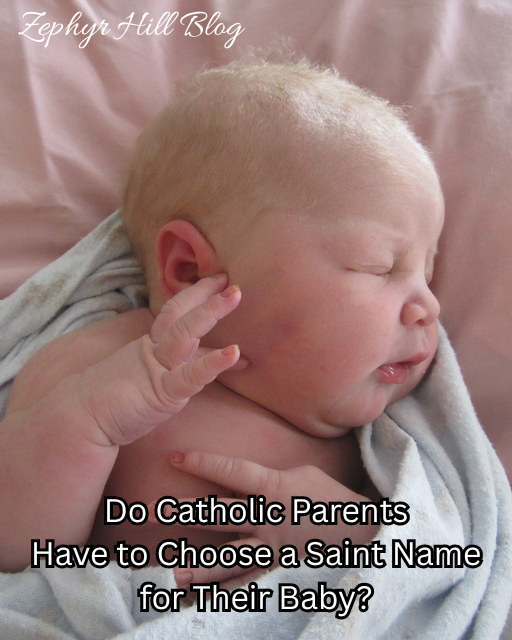
What a great post! Who is the baby in the first photo?
How about this mouthful of memorable ligit saints’ names combined for one tiny baby: Pachomius Pio Pancratius. For everyday use, he could go by Pach, Pio, or Pan. You’ve inspired me.
That’s Ingrid! Fair of face and quite fat!