Zephyr Hill

A Family Blog

Header Menu

  • Home
  • Contact Me
  • Terms / Privacy
  • Homeschooling
  • Faith and Family
  • Book Reviews
  • Cloth Diapers
  • Pets

The Origins of Pickleball, and Other Silly Sports Names

August 13, 2024 by Anne Marie 1 Comment

As a child, my favorite sport was badminton, and I always thought the name was so funny. It sounds like “bad mitten” when pronounced. But the game was first played around 1873 at the Badminton estate in Gloucestershire, England, and thus the moniker. It’s the flight of the shuttlecock (another whimsical name) that defines this low-intensity racquet game which can be played in singles or doubles, much like tennis. Incidentally, the English originally called the small racquet a battledore, stemming from the ancient French batedor (to beat, or a beater).

And now we come to pickleball. My family really took to this badminton-ping pong hybrid when two new courts were installed at our local park. The idea was conceived in the 1960’s by three fathers who were trying to drum up some summer fun for their children but didn’t have any tennis equipment on hand. So they improvised with ping pong paddles and “whiffle” balls on the old tennis court instead. Guess what? The balls bounced delightfully well on the court, so they lowered the net and created a new game based loosely on badminton rules.

True to its founding, pickleball is truly a family game. Our 2nd grader enjoys it just as much as we do! All you need are a few rackets and some perforated plastic balls to get started. A bag to hold everything and a comfortable pair of pickleball shoes are also handy.

But what about the name? For some reason, there are two theories (can these three fathers not remember why they chose the name?). Number one says that combining several sports in one is similar to the way that pickle boat crews are composed of oarsmen from the leftovers of other boats. Theory two is that one of the founders had a dog named Pickles who loved to chase the ball. Whatever the reason, it’s both silly and memorable.

Pickleball

Now let’s move from America to New Zealand. Someone there felt very strongly that rolling down the hill in a massive bouncy ball would be highly enjoyable, and zorbing was born. Also known as globe-riding, or sphereing, the intrepid cowboy inside can opt for straps or no-straps, depending on how strong his stomach is.

On the other side of the world, Germany has created an usual sport that centers around a stool. While it’s classified as an “extreme sitting” sport, there is surprisingly no beer drinking involved in sporthocking. Rather, participants perform any number of tricks with the seat, including spinning and kicking, throwing and even juggling. And you’ll never guess what the grand finale is. You sit down on the stool.

Speaking of beer, I’m fairly certain that bog snorkeling was born over a good pint (or three) of ale in Wales. Why else would someone don a snorkel and flippers and swim a 60-yard murky bog trench? Wet suits are optional in this one, but advisable!

Not only unusual but hard to say, clog cobbing is just a bunch of Brits throwing their shoes around. Specifically, one must lob (or cob to use the English slang) a lovely leather Lancashire clog as far as possible, taking care to mind that it doesn’t plop into the water. Even children can compete in this one. Here’s a video clip.

It’s fun to say haxey hood, isn’t it? This is a local English sport dating back to the medieval times and looks sort of like rugby, but has few rules and involves hundreds of villagers, lots of singing and plenty of shoving. Play centers around a leather hood (tube) which is pushed and pulled in different directions in a big scrum. Two things are not allowed: running with the hood or throwing the hood.  But there’s no law against drinking beer while doing your part to move the hood along.

The goal is to navigate the leather tube into one of the four pubs in the town, and the game is over when the pub owner touches the hood while standing at the threshold. He then gets to display it for a year in his tavern. As a spectator sport, this one ranks kind of low on the totem pole because there’s no way you can even see the hood or who’s controlling it in a massive scrum!

By the way, if you’re into weird and wacky games, then check out the World Alternative Games website. Whether you’re into wife-carrying, chariot racing, underwater hockey, or good ‘ole Paper Rock Scissors, this is your crew. Events are held sporadically in Wales, and it hasn’t quite gotten into a reliable two or four year rhythm like the Olympics yet.


 

Filed Under: Faith and Family, History

The Servant of Slaves: Henriette DeLille

August 8, 2023 by Anne Marie Leave a Comment

Born in 1812 on Burgundy Street in New Orleans and baptized a Catholic, Henriette had a French father and a Creole mother, with French and Spanish and African ancestry. Never legally married, Henriette’s parents operated under a system called placage, common in the French colonies where white men faced a shortage of wives of the “ideal” color and class. These “kept women” of African, Indian and Creole descent were called placees. Although not legal, these relationships were recognized among the free minority populations; the women and their resulting children (who would adopt the father’s surname) lived comfortably and moved freely within an active social circle.

Thus, young Henriette led a comfortable life in the city, schooled in French literature, music and dancing, with her future life destined to look like her mother’s. But Henriette was absorbing other things in her upbringing, namely the teachings of the Catholic faith. Inspired by her love of God and His laws, she would later become an outspoken opponent of the placage system; true, it was an easier life for bi-racial women, but it represented a violation of the holy sacrament of marriage, instituted by Christ Himself, and an affront to the dignity of women.

In 1827, at the age of fourteen, this gracious and well-educated young lady began to educate other Creole girls at Saint Claude School. Over the years, as she brushed elbows more and more with the underprivileged, the seeds of her future mission were being planted. It was around this time, too, that funeral records indicate teenaged Henriette might have given birth to two little boys, both named Henry Bocno in succession and both who died very young. This points to the possibility that she had already been “placed” with a wealthy man, but no conclusion has yet been reached by historians about these records.

But sometime after receiving the powerful sacrament of confirmation at age 22, Henriette’s life began to turn in a different direction, and big changes were imminent. A year later, her mother tragically suffered a nervous breakdown, and when the court declared her incompetent, that left young Henriette in control of the family assets. These she used to find a suitable place for her mother; the rest was sold. Henriette, whose only recorded written words were “I believe in God. I hope in God. I love God. I wish to live and die for God,” had always labeled herself a “free colored person” even though she and her family were octoroons (or 7/8 white). Because of this she was denied entrance into the exclusively white Ursuline convent.

Finding another way through the racial red tape of the day, Henriette took the proceeds of her asset sale and organized a modest (but officially unrecognized) gathering of nuns called the Sisters of the Presentation. This original group included Henriette, seven Creoles and a young French woman.

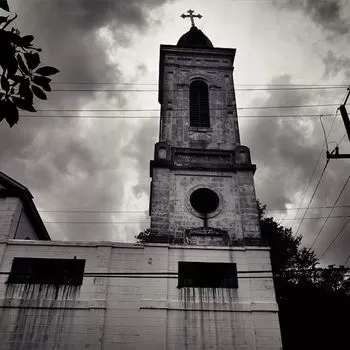
The Sisters of the Holy Family, the name of her order which was eventually sanctioned by the Church, took shape during the 1840’s. The founding members took their vows on bended knee in old Saint Augustine Church in New Orleans (below). From Henriette and her fellow sisters, slaves received free education and catechism, even though teaching slaves put the nuns at risk of imprisonment or even death. They counseled free Creole women to marry men of their own class, and encouraged slave couples to have their unions blessed by the Church. The elderly, sick and poor also found refuge in the home that DeLille made possible.

In 1853, Henriette and her sisters nursed the sick and dying during New Orleans’ horrific yellow fever epidemic.

Twenty years after taking her vows and spending herself in the service of others, Henriette DeLille passed away at the young age of 49 from illness, while New Orleans was under occupation by the Union army. This obituary appeared in a local New Orleans paper:

Last Monday died one of these women whose obscure and retired life was nothing remarkable in the eyes of the world
but is full of merit before God… Without ever having heard speak of philanthropy, this poor maid had done more good
than the great philanthropists with their systems so brilliant yet so vain.

Courage is most certainly one of Henriette DeLille’s outstanding virtues. She boldly left her comfortable life behind, and even placed herself at odds with family by refusing to hide her African ancestry. Advocating against an entrenched social system and defying the law to give slaves an education, Henriette was a fighter who put her life on the line for love of neighbor. Showing great faith and hope, she founded a religious order for biracial women, knowing full well that approval was not assured, but trusting that God would work out the details and help it to flower.

Her cause for canonization was opened in 1989 and advanced by Pope Benedict XVI in 2010. She is the first native born American of African descent whose cause has been opened by the Church.

The stylized painting below not only capture’s Henriette’s compassionate and generous nature, but is imbued with that marvelous character that only New Orleans possesses. The lanky green shutters, old brick walls and palm fronds all vie for attention among a gathering of people, varied in both country and color. In 2011, the City of New Orleans named a street after Henriette.

Detail from a work by artist Ulrick Jean-Pierre,
which is hanging at the Sisters of the Holy Family Motherhouse in New Orleans

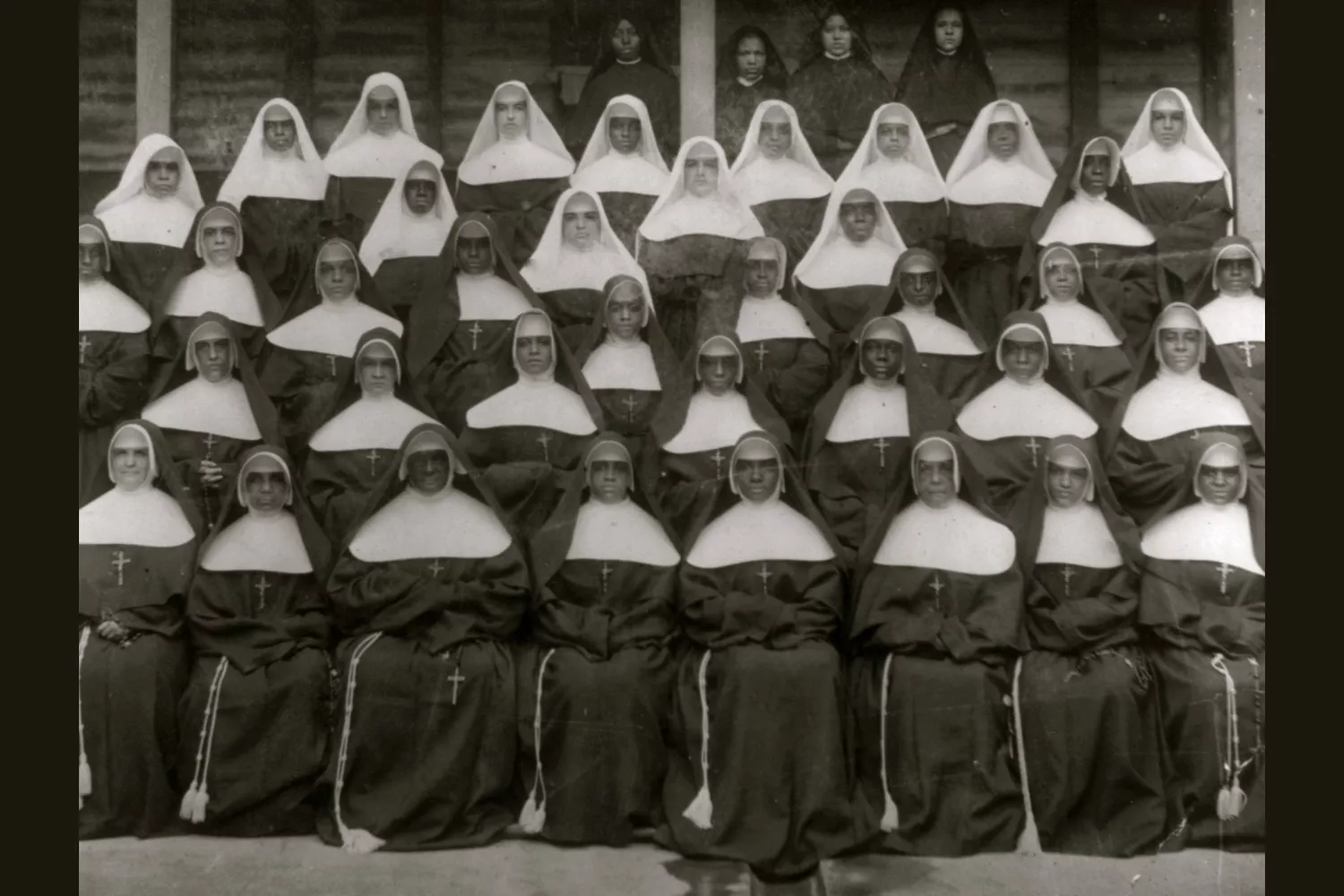
When death freed her from the bonds of Earth, Henriette left behind 12 fellow sisters; by 1909 the order had grown to 150. The sisters are still active today, with more than 200 members who serve the poor by operating free schools for children, as well as nursing homes.

Sisters of the Holy Family, 1899 Buyenlarge/Getty Images

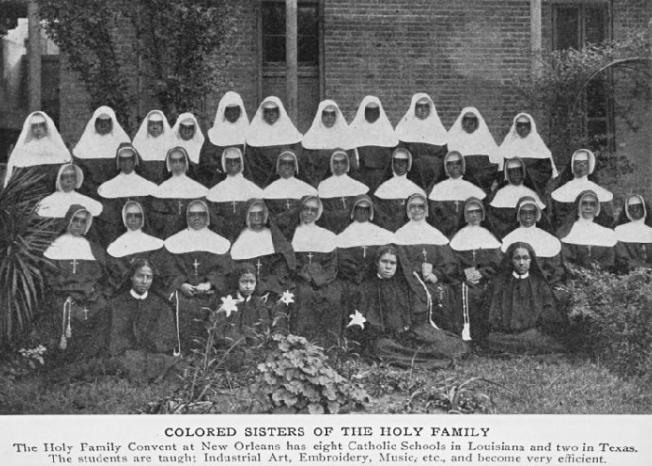
The photo below shows the sisters again in 1905.

In 2013, a miracle attributed to her intercession was approved!

Venerable Henriette DeLille is a reminder for all of us to never forget the vulnerable, the unseen, and the voiceless. God looks not at color or class, but the heart.


Credit: The title image in this post is a colorized photo painting by Saints Alive Art Studio.

Filed Under: Faith and Family, History

5 Titanic Mysteries That Will Never be Solved

April 3, 2018 by Anne Marie 28 Comments

This is the 2nd post in my Titanic series

“It’s a rash man who says he knows the final answer to anything having to do with the Titanic.”
Walter Lord, author of A Night to Remember

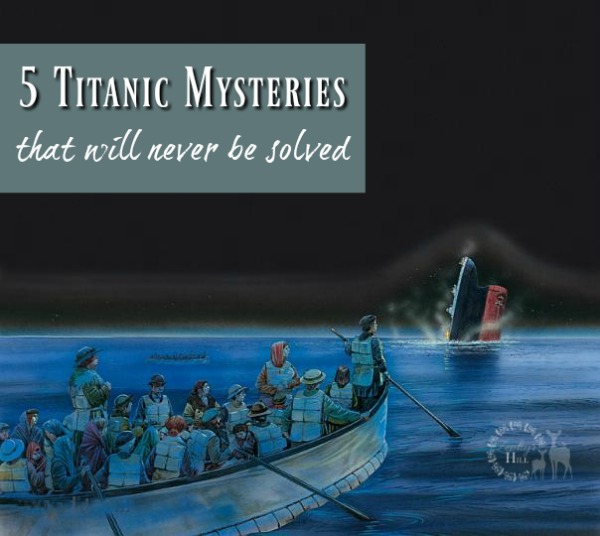
The iconic passenger liner Titanic, which now lies over 2 miles below the Atlantic Ocean, has given up some of her secrets since Dr. Robert Ballard first discovered her wreckage in 1985. But five mysteries still remain, and still befuddle Titanic aficionados.

#1 What happened to Captain Smith in his final moments? We know that he went down with the ship, in that chivalric maritime tradition, but what about his last minutes? Some say he tenderly held a boy and girl in his arms until the end. Others saw him on the bridge, later to be swept away as a wave of water washed over. A few claim that he jumped into the water and was invited into a lifeboat, but turned away and selflessly headed back to his ship.

Officially, the last mention of the Captain’s whereabouts came at 2:10 a.m., when Steward Edward Brown saw Smith with a megaphone in his hand. “Well boys,” he said sadly, “Do your best for the women and children, and look out for yourselves.” Captain Smith then walked out onto the bridge alone; barely 10 minutes later, Titanic plunged to the bottom of the ocean.

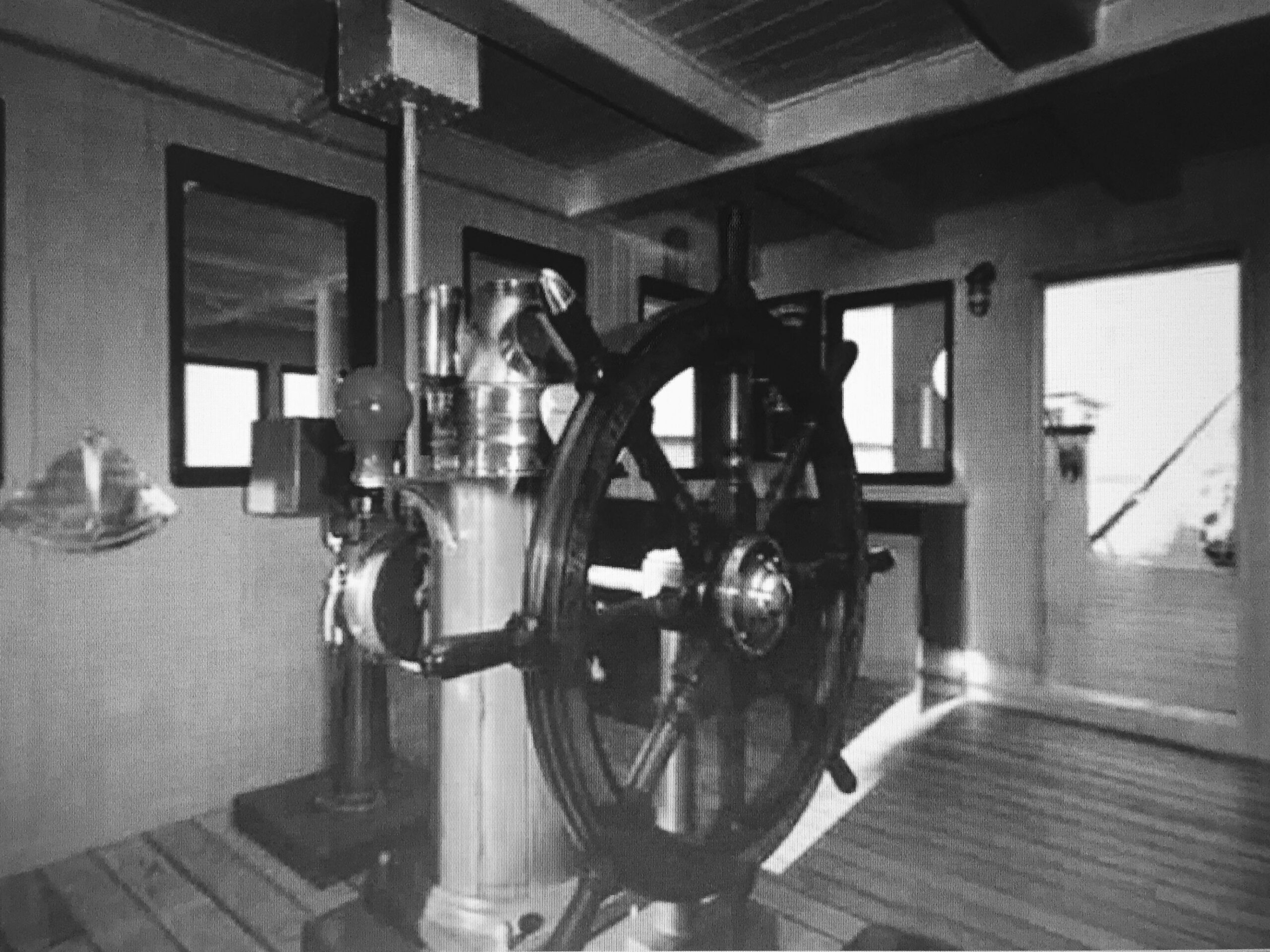
Titanic’s bridge or wheelhouse

Robert Williams Daniel, an American banker who survived by jumping off the stern and somehow making it into a lifeboat, testified: “I saw Captain Smith on the bridge. My eyes seemingly clung to him…The water had risen slowly, and was now to the floor of the bridge. Then it was to Captain Smith’s waist. I saw him no more. He died a hero.”

Since there are several conflicting claims from survivors, and no real way to disprove one or the other, Smith’s final moments will always be veiled in mystery.

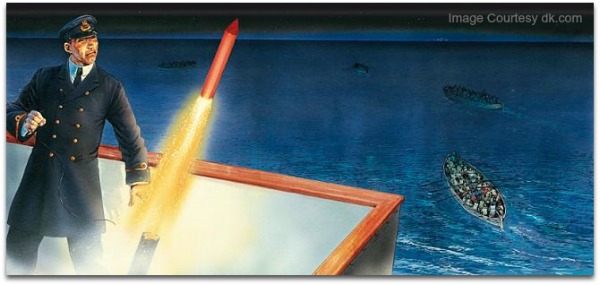
#2 What about the Californian and Captain Lord’s response to Titanic’s signals? One particularly dicey outcome of the Titanic disaster was Captain Lord’s ordeal as master of the Californian, as he was roundly criticized for his apparent lack of response to the foundering Titanic. And what about all those distress rockets that Titanic’s officers kept firing? The crew of Californian clearly saw them, but had conflicting opinions about what they meant. Lord also failed to enter the incident in his log.

Lord’s sharpest detractors claim that he failed in his duty to at least attempt some type of rescue. His enemies and advocates (dubbed Lordites) have gone back and forth about it for years. Lord’s own son worked tirelessly for years through the court system, trying to clear his father’s name.

Lord was implicated by a British investigation which was published in 1992 by the Marine Accident Investigation Branch. It criticized the officers’ response to the signals and concluded that the rescue of some survivors could have been accomplished. In 2009, author David Allen Butler described Captain Lord as a negligent sociopath.

We will never be 100% certain about distances and visibility on that tragic night thanks to ambiguous and conflicting testimonies over the years, and the incorrect position reported by Titanic herself.

Providing what might be partial exoneration, the British government and historian, Tim Maltin, have explored the possibility that light refraction on the night of the sinking may not only have led to the deadly collision but also to Californian’s skewed view of the rockets. It may also explain why Captain Lord’s morse lamp signals were ignored by Titanic. Historical Paul Lee has also provided some meticulous research which attempts to explain Lord’s inaction, and also addresses some of the attacks on his character. Similarly, Senan Molony offered his own defense in 2006.

In my opinion, the jury is still officially out on this one, and no formal charges were ever brought against the captain. Additionally, even Lord’s detractors don’t all agree as to the extent of his “crimes” or his motives. Titanic scholars, researchers and afficianados still have not come to a unanimous verdict even to this day. And many of them question whether, thanks to logistics, Californian could have even saved many lives, if any at all, had she headed towards the Titanic that night.

More recently, in 1992 the British government concluded that Lord’s ship was out of visual sight of the Titanic; however, they were critical of the response to the rockets which were seen. It is a fact that Captain Lord received many testimonials of good conduct throughout his career and many honorable people were willing to risk their own reputations to help him find employment with a line line after the Titanic tragedy.

With SO many human errors occurring on board Titanic herself that directly contributed to the sinking, many of which could have been easily avoided and might have saved thousands of lives, the focus on Lord’s involvement is (in my opinion) vastly disproportionate.

What is your opinion of Lord’s involvement in the Titantic fiasco?

#3 Did First Officer Murdoch commit suicide? By all accounts, First Officer Murdoch, the man whose maneuvers failed to thwart the iceberg’s death blow, worked bravely and efficiently for some time to get the lifeboats loaded and lowered away. And then, an eyewitness suggests that, Murdoch turned a gun on himself. In his words “I was sent down to take charge of No. 14 boat, but before I went one of the officers had shot himself on the bridge.” Many other witnesses reported directly or indirectly, Murdoch’s suicide, and the fact that most of them were near the boat deck or within view, gives added weight.

“One officer shot a man who attempted to get into a crowded boat. Immediately afterward
the officer said:-
“Well, goodbye,” and killed himself.”
(George Rheims, First Class Passenger)

It was intimated that either guilt or fear, or both, burdened Titanic’s First Officer and led to his suicide. After the sinking, several seaman charged that if Murdoch had kept a stricter lookout on the bridge (rather than reacting to a last-minute cry from the crow’s nest) he would have spotted the iceberg in plenty of time to allow for the ship to swing away. It is also generally agreed that had Murdoch rammed the berg head on, instead of turning and killing the engines, Titanic could have remained afloat long enough to get everyone off safely. Surely no one would have suffered deeply from the nightmare of “what if’s” than the ship’s First Officer.

At this point in time, no evidence has ever come to light Murdoch was not the officer seen committing suicide. His most notable defender, well-respected passenger Archibald Gracie, admitted that he didn’t even know Murdoch by sight. While we will never know for certain, there are enough testimonies to suggest that perhaps this seasoned seaman, who was on board his first ship at age 15, felt such crushing guilt over the tragedy he partially helped to in motion that he felt justified in ending his life.

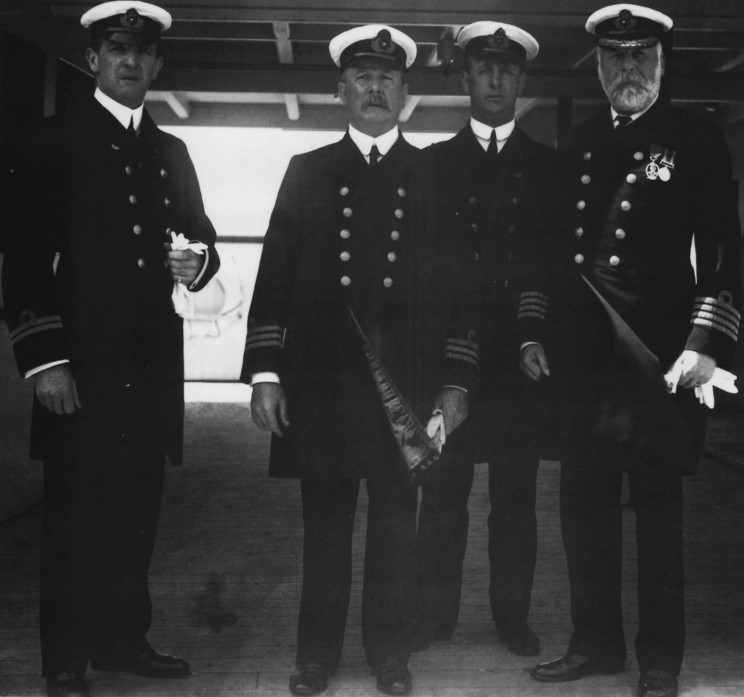
Murdoch on board sister ship, Olympic, at left (with Captain Smith at right)

#4 What happened in the wireless room? We know there was a scuffle in the Marconi room as the ship foundered, but what exactly happened is simply not clear. This is largely because the only surviving witness kept changing his story!

Wireless operator and survivor Harold Bride stated that he came upon a gripping scene in the room when he went to check on his colleague, young Jack Phillips. Bravely tapping out the distress calls, Phillips had no idea that a stoker was sneaking up from behind, intending to take away his life belt, by force if necessary. Bride’s actual words were “I had to do it. I could not let that coward die a decent sailor’s death, so I shot him down and left him alone there in the wireless coop to go down with the hulk of the ship. He is there yet, the only one in the wireless room where Phillips, a real hero, worked madly to save the lives of two thousand…”

In a story dictated to a New York Times reporter in 1912, Bride’s story was slightly different and mentions no pistol. “I did my duty. I hope I finished him. I don’t know. We left him on the cabin floor of the wireless room and he was not moving.” Here, too, he references Phillips, suggesting it was a two-man job.

Nine days later, while giving his official report to Marconi officials, Bride shifted again stating that he returned “to find a Fireman or Coal Trimmer gently relieving Mr. Phillips of his lifebelt. There immediately followed a general scrimmage with the three of us.”

On May 23, 1912, at the British inquiry, Harold Bride’s tale received yet another coat of varnish:

EXAMINER LEWIS: You are supposed to have hit him?
HAROLD BRIDE: Well, I held him and Mr. Phillips hit him.
EXAMINER LEWIS: Mr. Phillips hit him?
HAROLD BRIDE: Yes.
EXAMINER LEWIS: That is the difference between what you say and what I read.
You are absolutely positive on this question?
HAROLD BRIDE: I am positive on it, yes.

It is fascinating to see the evolution of Bride’s story as it morphs from him gunning down a man, to him simply holding the man as Phillips finishes him off. And his friend Jack Phillips’ lips are sealed at the bottom of the sea.

#5 Did the officers actually shoot people while Titanic was sinking? Some Titanic survivors claim that officers shot and killed a few people that caused trouble during the lifeboat-loading phase. Others assert that order was kept without any passengers being shot.

“These men tried to rush the stairway, pushing and crowding and pulling the women down. Some of them with weapons in their hands. I saw two dagos [i.e. Italians, an ethnic slur] shot and some that took punishment from the officers.”
(Eugene Patrick Daly, 3rd Class Passenger from Ireland, sharing his story while on board the rescue ship Carpathia)

“While the last boat was leaving, I saw an officer with a revolver fire a shot and kill a man who was trying to climb into it.”
(George Rheims, 1st Class Passenger, from a letter to his wife in France dated April 19, 1912)

“I was on the boat almost to the last, and I didn’t see anyone shot.”
Henry Stengel

While it is an established fact that the captain and some of the officers possessed firearms, which may have been used to assert their authority during a crisis, no one has been able to verify anything for sure beyond that, although the evidence may lean towards shots being fired, because those who claim they saw nothing, while likely speaking the truth, simply did not have a full view of the entire ship during her sinking. Boats were being loaded on both port and starboard sides.


The Problem With Eyewitness Accounts

Eyewitness accounts are a tricky thing, especially after catastrophic events such as this. We tend to think “He was there, so he must know the truth!” but history shows us it isn’t that simple. Why?

  • Stress can affect our memory.
  • Emotion and personal opinion may cause us to embellish or insist upon things that we actually do not know for certain (example: if you were mad about Ismay – director of White Star Lines – getting off the ship alive while her Captain and architect perished, you might be inclined to believe that he shoved his way into one of the first boats).
  • Location and visual conditions matter very much when it comes to what we are (and are not) able to observe. Many Titanic survivors testified to things that they could not possibly have seen or heard, given their location.
  • We are affected by other people’s testimonies, as well as what we read in the news.
  • When someone lacks distinctive characteristics, our testimony may be less reliable. How many of Titanic’s survivors who accused Ismay of cowardice even knew what he looked like, or could accurately spot him from a distance in the middle of a panicked scene?
  • The press often asks leading questions that can steer a survivor one way or the other.
  • We want to be helpful (to the authorities, to the newspapers, etc.), and may claim we know or saw more.

Psychologists have found that our memories are reconstructed rather than played back each time we recall them. It’s more like putting together a puzzle than it is like playing a DVD recording.

But still, survivor accounts, together with official records and other data, do still have a great deal of value.


Other sources, besides linked articles:

Eaton, John P. and Haas, Charles A. (1996). Titanic: Destination Disaster. W.W. Norton & Company.
Lynch, Donald, Marschall, Ken and Ballard, Robert D. (1995). Titanic: An Illustrated History. Hyperion.
Marshall, Logan. (2006). On Board the Titanic: The Complete Story with Eyewitness Accounts. Dover Publications
Mowbray, Jay Henry. (1998). Sinking of the Titanic: Eyewitness Accounts. Dover Publications.

Filed Under: History Tagged With: Titanic, Titanic history, titanic mysteries

7 Titanic Books That Your Children Will Love

December 14, 2017 by Anne Marie 6 Comments

My children are a bunch of Titanic buffs because they grew up watching me devour book after book about one of history’s most legendary ships. Ironically, you will never catch this Titanic afficianado aboard a luxury liner. I’m a poor swimmer and an avowed landlubber. Traversing the ocean’s depths in the pages of a good book is my preferred mode of travel!

My children and I have sailed through many Titanic books together (and watched several film adaptations). Here are some of our favorites:

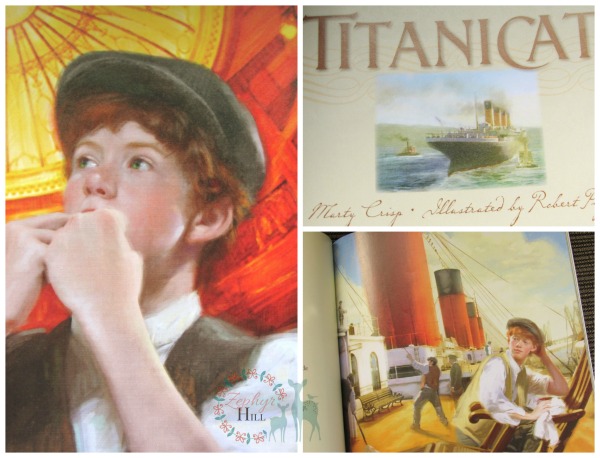
Titanicat – (Marty Crisp and Robert Papp, 2008, ages 6 and up). When I first spotted this book, I assumed it was a fanciful tale for cat lovers that cashed in on the Titanic’s never-ending fame. I was wrong. Titanicat is based on the true story that came out in the 1990’s of a young Irish fellow who was asked to take care of the ship’s cat, and disembarked before she went to her doom. The narrative is bright and engaging, with gorgeous photo-realistic paintings of Titanic inside and out (see the one of green-eyed Jim with the Grand Staircase dome sparkling above him?). Young children will love the oversized pages and cozy renderings of the ship’s cat (named “401”) and a surprise she brings on board.

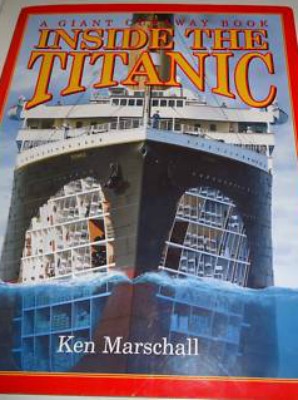
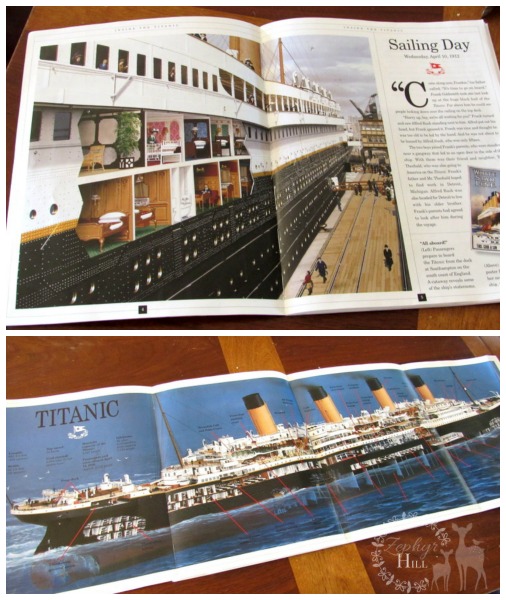
Inside the Titanic – (Illustrated by Ken Marschall, edited by Hugh Brewster, 1998, recommended for ages 6 and up). Ken Marschall, one of Titanic’s most famous painters, teamed up with editor Hugh Brewster to publish this book of highly detailed, cutaway illustrations for young Titanic fans who crave more details. Of all our books, I think this one really gives the best sense of Titanic’s massive size and spectacular fittings. Some of the pictures are absolutely riveting, including an eerie underwater view of Titanic’s bow as she sinks. Besides being full of technical details, there are true stories of children who sailed on the doomed ship. The book also includes a large, diagrammed pull-out poster of Titanic.

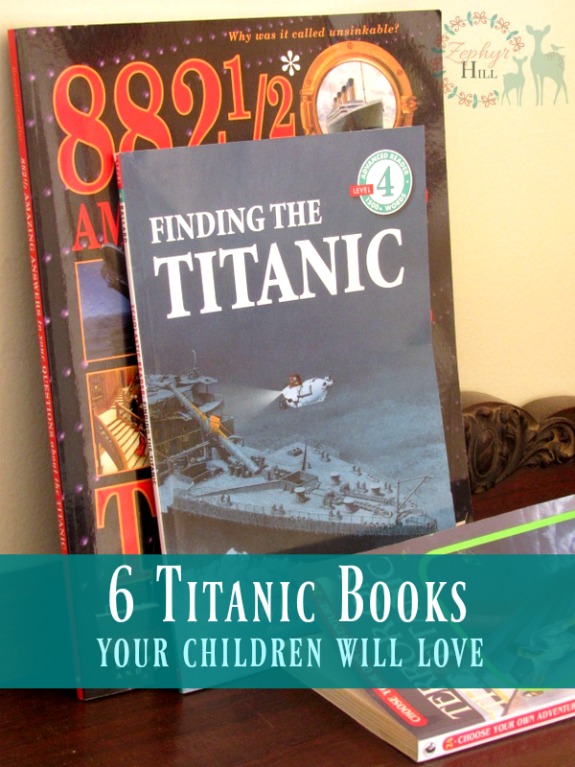
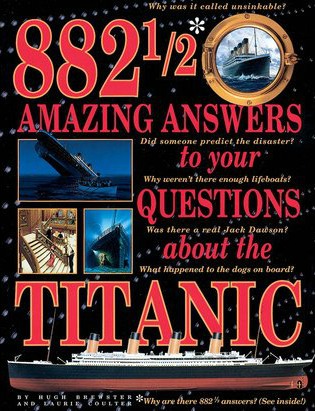
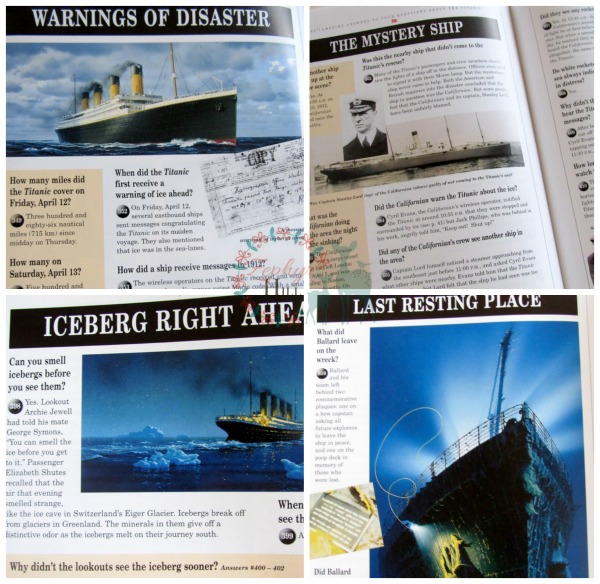
882 1/2 Answers to Your Questions About the Titanic – (Hugh Brewster and Laurie Coulter, illustrated by Ken Marschall, 2012, ages 8 and up). The minute you read the cover, you’ll get sucked into this book, because at the very bottom it asks “Why are there 882 1/2 questions?” To get the answer, you’ll have to open the book and start reading! Brewster and Marschall team up again, along with Laurie Coulter, to take you through the entire Titanic journey, from plans to perishing, in a Q&A format. Your children can pick this up and read in small bites, or get lost in it for hours. There are plenty of beautiful paintings, photographs and detailed diagrams throughout, plus a special feature which was added in 2012 on the making of James Cameron’s movie. It even has questions you might not think to ask like “Can you smell icebergs before you see them?” making this a book that pretty much anyone, not just Titanic fans, can learn from and enjoy.

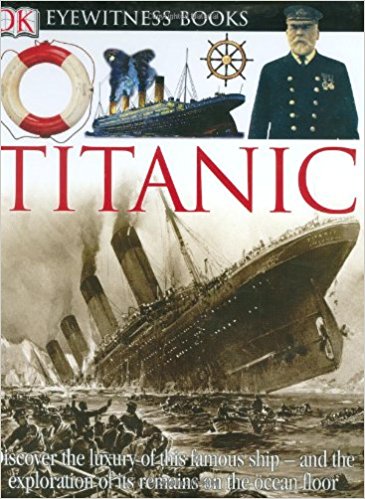
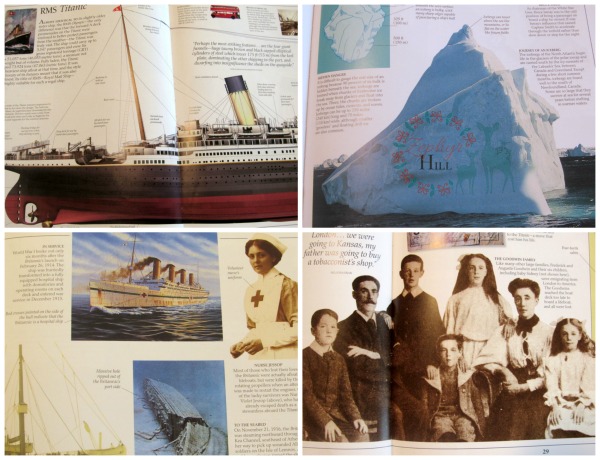
Titanic (DK Eyewitness Book) – (Simon Adams, 2004, ages 8 and up). Here’s another addition to your Titanic library which is easy to read in small bites or in one long sitting because it’s packed with pages of fascinating facts organized by topic. It begins at the Belfast shipyard and ends well beyond Titanic’s sinking, covering more recent events like her discovery in the 80’s, lessons learned from the disaster and little-known tidbits of trivia. There are also 2 pages of resources for young explorers who crave more, and a bonus clipart CD-ROM of Titanic images. I’ve been reading Titanic lore for years and discovered many new things in this DK book!

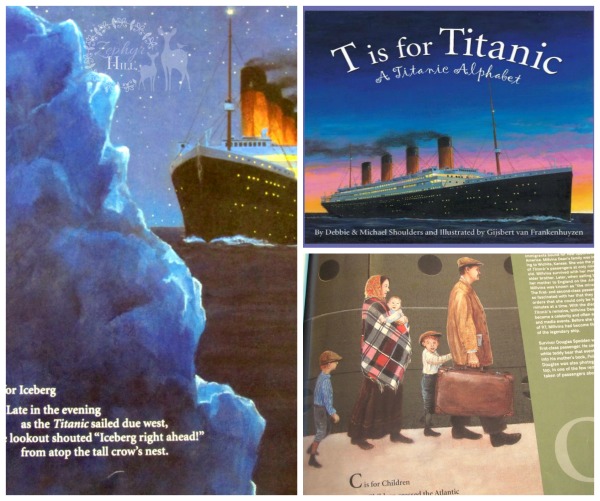
T is for Titanic – (Michael and Debbie Shoulders, illustrations by Gijsbert van Frankenhuyzen, 2011, grades pre-K and up). Your child will enjoy perusing this generously sized (11×10 inches) alphabetical, artistic salute to Titanic history. Each page focuses on one letter (“G is for Grand Staircase”) set against a backdrop of lush, evocative paintings in full color. Follow the “Floating Palace” from her brief days of glory to her unbelievable demise. Set this slim, hardcover volume out on your coffee table and watch curious adults pick it up, too!

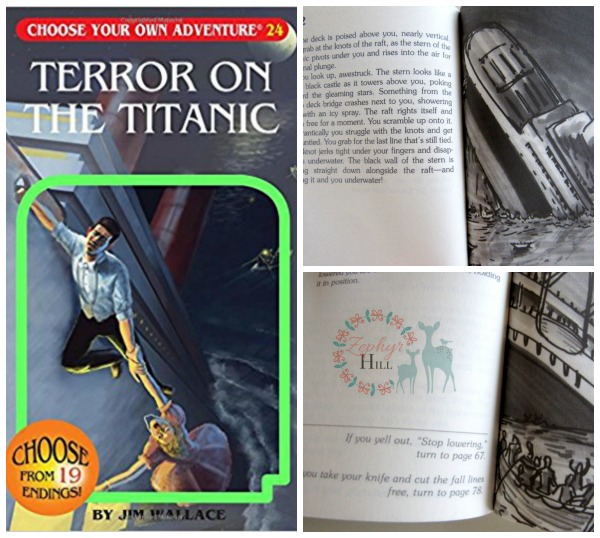
Terror on the Titanic (Choose Your Own Adventure) – (Jim Wallace, 2007, ages 9 and up). If you’re an 80’s or 90’s child, then you are already familiar with “Choose Your Own Adventure” books. The story changes based on choices that the reader makes throughout the narrative. Titanic’s true story is a fascinating exercise in “what if’s” so it’s perfect for the Choose Your Own Adventure model. Do you help Fourth Officer Boxhall fire distress rockets or assist with loading the lifeboats? Do you go below decks and try to grab your valuables before Titanic sinks, or do you stay up top and hastily assemble a life raft from deck chairs? Each choice your child makes could mean life or death, and there are nineteen different possible endings. Hopefully, he or she will end up wrapped in a warm blanket on board the welcoming Carpathia, and not at the bottom of the icy Atlantic……

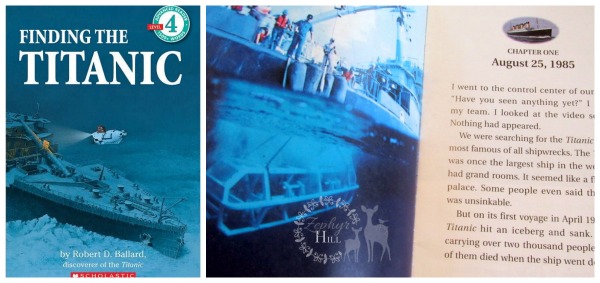
Finding the Titanic (Hello Reader, Level 4) – (Dr. Robert Ballard, 1993, recommended for grades 3 and up). Discovering the wreck of the Titanic was a bombshell story in 1985. After more than 70 years, the world had nearly given up hope of ever finding history’s most famous super liner. Dr. Robert Ballard spins his exciting discovery story for independent young readers in this small paperback edition.  He includes plenty of color photographs of the expedition. I like that Dr. Ballard honestly shares his opinion about salvaging the Titanic graveyard, a topic very close to his heart as both a devotee and discover.

If you have any Titanic-themed book or activity recommendations for children, please share in a blog comment below!


Filed Under: Book Reviews, History Tagged With: best titanic books, childrens books, Titanic, Titanic books, Titanic books for kids, Titanic history, white star lines

SOCIAL MEDIA

Newly Published

  • The Coop Upgrade Nobody Talks About Until It’s Too Late
  • Ignore the Radio Ads About Life Insurance, But Please Read This Post
  • Do Catholic Parents Have to Choose a Saint Name for Their Baby?
  • The BEST and Most Comprehensive Baby Name Books for Parents
  • Educational Games to Enjoy With Your Children

Popular Posts

  • My Home Birth Story: Full of Surprises
  • Organics by Ti Bamboo Flats Review & Giveaway
  • Home Schooling with Limited Space
  • 5 Ways to Handle Food Throwing and Messy Eating
  • Outside-the-Box, Delightful Gift Ideas for 2022

Copyright © 2026 · Zephyr Hill Blog · Design by Albemarle PR

Copyright © 2026 · Albemarle PR - Hannah Template on Genesis Framework · WordPress · Log in