March 4, 2026
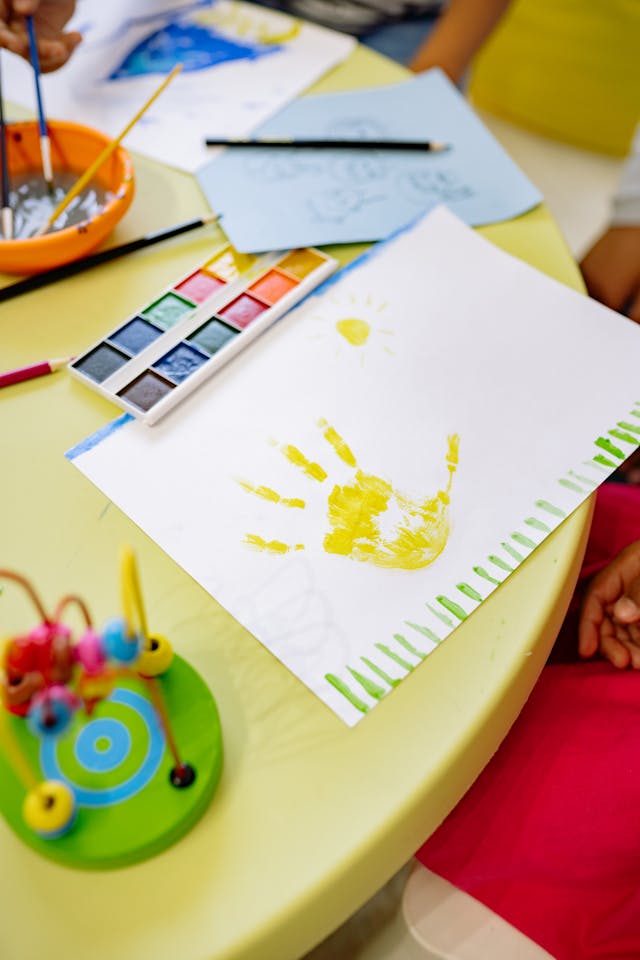
If someone asked you to imagine or describe ‘creativity’, you’d probably think of music, paintbrushes, perhaps even some craft DIY projects.
And, yes, there IS some truth to that, but that’s FAR from the entire picture.
Creativity, in a nutshell, is a person’s ability to think differently, their ability to imagine multiple possibilities, and generally solve problems with great curiosity. And no, curiosity isn’t some talent we’re born with. Rather, it’s something that can be taught/instilled.
So, if you have a child who isn’t particularly creative, don’t worry. In this article, we’ll go over how you, the parent, can teach your child to be as creative as he can be.
All you’ll require is knowledge and determination, and all he’ll need is space and support. In order for children to be creative, they need to be given a chance to actually BE creative.
So, let’s dive into how we can get there.
The Beginning of the ‘Curious Path’
Regardless of how creative (or not creative) your child is, you have to be aware of the fact that at the heart of every creative child is curiosity. Curious children ask questions.
So, this is where we’ll start.
They wonder why things work the way they do. They explore. And most of the time, they explore with imagination.
What parents can do here is help by encouraging open-ended conversations. And children, if they aren’t in the habit of doing so, might need a bit to get used to this. It has to become part of their daily routine.
So, instead of you giving them direct instructions, what you can do is give them vague (or very basic) instructions. And tell them to ask questions about the task(s).
Here are a couple of example questions, so you get the idea:
- What do you think will happen?
- Why do you think it happened?
- How could we try this differently?
- What else could we do?
Instead of simply giving them the answers on a platter, it could be more productive to guide our children toward the answers – or at least give them a little nudge.
Questions help children develop independent thinking. They learn that their ideas matter. They learn a new approach.
And over time, that could build confidence, intellectual flexibility, and creativity.
The Environment
Creating an environment that encourages imagination might be a good place to start. Children are naturally imaginative. Their environment can grow or limit their imagination. It doesn’t need to be expensive.
It could be something simple, filled with ordinary everyday things such as:
- Blank paper
- Building blocks
- Recyclable materials
- Story prompts
Toys can be used in many ways to encourage problem-solving.
They don’t have to be expensive or even an actual toy, for that matter. Even everyday things, not just products that are designed for children, can be used as a toy. A cardboard box can become a spaceship, a house, or a treasure chest.
That transformation process is basically creativity in action. And it entirely depends on the child in question.
When you provide kids with plenty of materials to choose from, they’ll basically become designers of their own little ideas and the makers of their own world.
Boredom Mightn’t Be All That Bad
In today’s world, we’ve been conditioned to believe that boredom is bad.
Most people don’t want to be bored, and most parents, especially, don’t want their child to be bored, as boredom is generally not a pleasant feeling nor a feeling considered good.
But most of the time, boredom can be the backing force behind creativity. If we’re bored, we take steps to alleviate that boredom. In short, it is a force that propels us to change something in our current state and environment.
Wouldn’t the same count for children? Although adults and children take different steps, in the end, their goals are the same. Their goal is change.
One of the ways children might approach that said issue would be to create games, build stories, and explore their surroundings with a fresh and inquisitive perspective; it might push them toward internal creativity rather than external stimuli.
Creativity Is Great For Character Development
When children create, they develop qualities that not only shape their imagination, but also shape who they will become – it shapes their character.
A creative child often learns patience while working on a drawing or building project. They develop a persistence that wasn’t there before. The persistence to solve problems through curiosity, resilience, independence, and confidence.
And it doesn’t even have to be a chore or some difficult task. IT can be a simple and fun puzzle to solve.
And this is where the concept of a character template can be extremely helpful.
Don’t go on thinking that creativity is this random skill that someone has on their character/personality sheet. No.
Parents should go about it from a different angle. Think of your entire child’s personality as an extensive character template. And what you want to do is add and then level up this ‘creativity’. It’s almost like when you’re creating a character in a book or in a video game. You create a foundation using a character template. But then, as the story progresses, that character sheet changes – things get added, others get removed, some are augmented. And as all this is happening, that’s still the same character from the beginning, only more evolved now compared to before.
If creativity becomes part of a child’s personality, it’ll also play a major role in their everyday decision-making. This will help them become better problem solvers. When children are encouraged to think creatively, they are also encouraged to think independently.
They learn that their voice matters. They learn to trust their ideas. They learn to think on their own.
Conclusion
Holding your child’s hands is NOT a bad thing. It’s called being a sensible parent.
But a sensible parent must also know when to hold their kid’s hands and when to let them go. Some situations require our children to grow up on their own, at least for a little bit.
Author: Jason Dunlap (Guest Post)