Zephyr Hill

A Family Blog

Header Menu

  • Home
  • Contact Me
  • Terms / Privacy
  • Homeschooling
  • Faith and Family
  • Book Reviews
  • Cloth Diapers
  • Pets

5 Things I Loved About my Home Birth

December 13, 2018 by Anne Marie Leave a Comment

I’ve given birth ten times and those experiences have varied widely. My first was a c-section, my next was in a hospital with epidural, the six after that were natural/birth center, and the last two were home birth with a midwife and assistant.

Here’s what I liked best about having a baby at home:

Well…you’re at home!

When it comes to an intense and tiring experience like labor, I concur with Jane Austen: “Ah! There is nothing like staying at home for real comfort.” I didn’t have to pack a bag filled with things from home that would make a hospital room more comforting. I was home, in my own room, my own bathroom, my own bed, surrounded by familiar people and things. Heck, even the cats came to visit me at the window during labor!

I didn’t have to leave in the middle of the night for a rushed car trip to the birthing facility. And when it was all over, we didn’t have to fool with car seats and checkout procedures.

There’s no hurry, and no pressure.

A midwife-assisted pregnancy and home birth is never rushed. Whether it was my nine months of prenatal visits or our complimentary postpartum home visits, the midwife allotted plenty of time for everything. Oftentimes, we would simply chat when the necessary checks were done.

This contrasts quite dramatically from my hospital experience, where staff is constantly checking on your “progress,” and exerting subtle pressure to hurry things along.

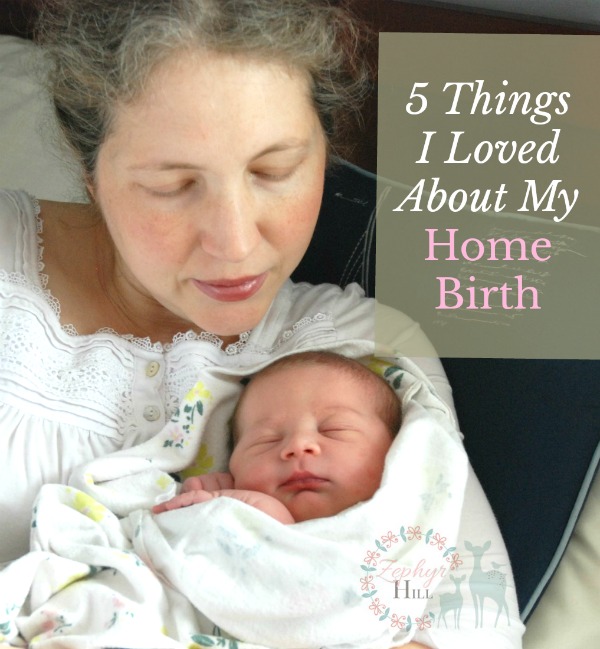
Laboring at home is low pressure. Arriving two hours before pushing time came, the midwife and her assistant hung out in the adjacent room, only coming in every once in a while to offer a drink or ask if I needed anything. After Camille was born, they both stayed another three hours to ensure all was well.
You make the rules.

And that’s as it should be because you’re having a baby, not undergoing brain surgery. That means you can wear whatever you want, move around (or be still) at will, and refuse this or that “intervention.”

When in the hospital, you play by hospital rules. I’ve experienced firsthand the senseless red tape and one-size-fits-all-policies (many of which are driven by insurance and government regulation).

When I first became pregnant with Camille, I called the one hospital in our area that offered VBAC’s and asked about their labor policies. I would be hooked to an IV “just in case.” I would be continuously monitored/tethered “just in case.” I would have a catheter inserted “just in case.” And the doctor may or may not allow me to give birth in whatever position I wanted. After just a few minutes, I was thinking “No, thanks!”

It’s family friendly.

How about making your own visitation policies? There are no restrictions when it comes to who you’d like to have present or who can come visit the new baby. And if labor starts in the middle of the night when your children are sound asleep, there’s no need to call a babysitter so you can rush to the hospital. Just let them sleep away. They’ll wake to a wonderful surprise!

Catherine welcoming her new baby sister, Camille

It saved us money.

My husband is fortunate to have an employer who is very supportive of home birth; our last two have been 100% free. But even without a program like this, home birth can be significantly cheaper than both hospitals and freestanding birth centers.

A midwife’s fee ranges from $1,500 to $3,000. A hospital birth can be $10,000 or more. Some health plans cover home birth, and some do not. It’s also possible to appeal with your insurance company, and get it covered. If the midwife you chose is not covered, you can ask for an in-network exception. All of this takes time, and can be a hassle, but if you’re paying for health insurance, then you should be getting the most out of it! Midwifery is just as valuable and worthy of coverage as other forms of obstetrical care.

Other options for funding a home birth include private plans or a health savings account.



Filed Under: Faith and Family Tagged With: home birth, home birth cost, home birth pros cons

What is it Like to Have a Home Birth?

December 17, 2013 by Anne Marie 12 Comments

Like me, you might be curious about giving birth at home. It’s an option my husband and I have considered before. Our deliveries at the local birth center do offer a “home-like setting,” but it’s still not the same as bringing a baby into the world at your own house. I decided to interview my dear friend and neighbor who has lots of experience under her belt. You might wonder “who is a good candidate for home birth?” The general recommendations are:

  • A mother with a healthy, low-risk pregnancy
  • A mother who is diligent about becoming informed and finding an experienced midwife or doctor
  • A mother who has reasonably easy access to emergency care, should a situation arise that the home birth practitioner deems is beyond her scope of expertise.

And now….let’s see what my friend has to share about her experiences!

How many home births have you had so far?  Five home births.

How do you choose the midwife that will assist you at the delivery? Someone who I am comfortable with, has the experience I want and is willing to at least consider doing stuff out of the ordinary (breech, etc…), but also is cautious. I usually find them online and then call them and talk to them, eventually doing an in-person interview. 

Was home birth something that you and your husband knew right off you wanted, or was there a lot of research and discussion involved? Lots of research and discussion. We had heard of it, but it wasn’t until we grew frustrated with the hospital policies (in spite of having a great pro-life doctor) that we really felt pushed that way.

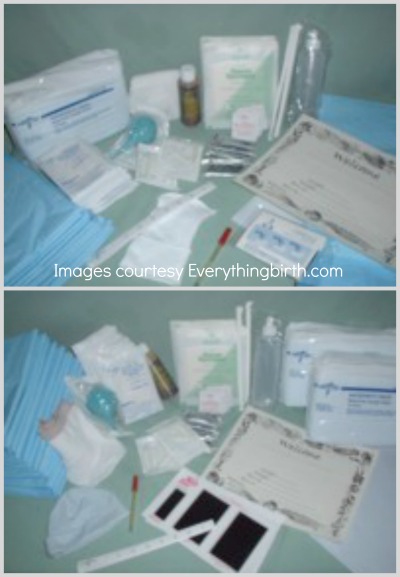
Is everything provided by the midwife, or are there certain things the family needs to buy for the delivery? A little bit of stuff is needed, like setting up your bed/floor so you don’t ruin it, and also a relatively inexpensive birth kit with cord clamps and the like in it [note from Anne: Everything Birth sells both customized and pre-packaged birth kits, as well as postpartum care supplies like peribottles, Glad Rags, Peri Compresses, lanolin and soothing herbals).

What kind of prenatal care did you have leading up to the birth? It’s basically the same as the doctor’s office; but not the ultrasounds (unless I requested one), and not the constant blood work (she still checks urine and blood iron levels). There is more that is left open to the patient to choose. For instance, they will do glucose testing, but don’t require it.

What types of medication and/or interventions does the midwife have at her disposal? Anti-hemmorage medication and oxygen for baby (it depends on the midwife). Most stuff they deal with naturally: for instance, there are only a few medical emergencies and they are trained how to deal with them until they can get you to a hospital. This would be a question you would ask each midwife individually because they differ. There are lots of natural alternatives to medication. For instance, Pitocin you can only get in the hospital, but if you break the water and use a breast pump it can also trigger labor (this worked for me!). They use a lot of herbs and stuff and I have found them to work wonderfully for increasing iron levels, etc…

How do your other children respond to the home birth experience? They love it! Each child has gotten to cut a cord of a younger sibling and they all talk about it. I’ve had to kick them out of the room, actually, for my own sanity during transition. Usually I just don’t let them come in unless they are old enough to be quiet because I have no tolerance for the noise in labor; I’m pretty snippy during contractions. LOL! After baby is born they all come in and it’s so sweet and joyous. Even the youngest ones are fine with it, even those who are in the room during labor.

How long does the midwife usually stay after the baby comes? A couple of hours. Usually she checks baby over fully, measures, cleans him up a little, cleans you up, checks you to make sure bleeding is slowing down, cleans up quite a bit and helps you shower off. Then she comes back in a day or two to check on you and baby again, and is in touch with you daily to see how things are going. 

Who cleans up everything? Midwife does the initial cleaning, and then there is laundry to deal with that usually my husband does.

What are your favorite things about giving birth at home? How laid back it is. It’s so peaceful. You are not bugged constantly, you can rest and your kids can enjoy your baby. Basically you can do what you want when you want, labor how you want, etc… you don’t have to work within any odd constraints put in place by sue-happy people. LOL! And the starkest thing is afterwards; baby can nurse and then sleep for a while and so can you. Kids can enjoy baby and there is no waiting to be released! It’s such an awesome time of rest and having hubby off of work. Love it! And one of the biggest things is that your baby’s care is not micromanaged. None of the unnecessary worries that the hospitals always have. You have parental rights over your children, not the hospital. And it’s WAY cheaper to boot! Your midwife is sensitive and you don’t run into evil nurses (most are great, of course, but you get to avoid the power hungry ones. LOL). Much more of a focus on educating yourself and eating healthy, living healthy, etc… I’ve learned a lot from home birthing!

Are there any drawbacks to home birth that mothers might want to be aware of? Not for me personally. A lot depends on the midwife and her experience, of course. You do have to educate yourself so you are prepared to make educated decisions. On the other hand, it’s no different than the doctors; after doing some research on a “top” doctor at the hospital I was amazed at things he was doing (like pulling the placenta immediately!). So I think it’s good to be educated, period.  

What is the most common response you get from others about your decision to give birth at home? That I’m “brave” and that they would not be able to do it. Or that they can’t believe I want to be home, that the hospital is a break for them. LOL! I think they are nuts. (wink)

Are there any books you recommend about home birth? Emergency Childbirth: A Manual (aff) is critical to read (you can find it free in some places online) so you can educate yourself about what CAN go wrong. You realize that it’s just a couple of things and know what is to be expected of you. 

How does home birth typically compare cost-wise to the hospital? Before insurance, a hospital stay averages about $10,000; home birth is $3,000 tops (many are lower). Hospital with insurance was about $3,000 for us; we paid about $1,000 for home birth, but this time around our insurance actually agreed to pay up front for the entire home birth.

If you have any more questions about home birth, ask them here and I’ll try to get you the answers!


Filed Under: Faith and Family Tagged With: home birth, home birth books, home birth cost, home birth questions, how to give birth at home, insurance cover home birth

SOCIAL MEDIA

Newly Published

  • The Coop Upgrade Nobody Talks About Until It’s Too Late
  • Ignore the Radio Ads About Life Insurance, But Please Read This Post
  • Do Catholic Parents Have to Choose a Saint Name for Their Baby?
  • The BEST and Most Comprehensive Baby Name Books for Parents
  • Educational Games to Enjoy With Your Children

Popular Posts

  • My Home Birth Story: Full of Surprises
  • Organics by Ti Bamboo Flats Review & Giveaway
  • Home Schooling with Limited Space
  • 5 Ways to Handle Food Throwing and Messy Eating
  • Outside-the-Box, Delightful Gift Ideas for 2022

Copyright © 2026 · Zephyr Hill Blog · Design by Albemarle PR

Copyright © 2026 · Albemarle PR - Hannah Template on Genesis Framework · WordPress · Log in