Zephyr Hill

A Family Blog

Header Menu

  • Home
  • Contact Me
  • Terms / Privacy
  • Homeschooling
  • Faith and Family
  • Book Reviews
  • Cloth Diapers
  • Pets

My Favorite Homeschool Memes, Volume 2

February 6, 2020 by Anne Marie 1 Comment

It’s time for volume two of my favorite homeschool memes! If you want to read the 2019 round-up, click here.

And now let the jokes begin…

Homeschoolers, wouldn’t you love a dollar for every time you’re asked about this?

Should I go easy on them just “cuz I can? Nah…….

Don’t ask! For goodness sakes, please just don’t ask!

Are you ahead or behind? That is the question.

The classic pitfall…if only we have the right books!

Don’t worry, you’ll survive!

We’re quite a diverse bunch, really!

Some people feel quite strongly about their educational choices!

It’s true that most homeschooling parents won’t get much recognition from the world for their hard work and dedication.

Parks, museums, libraries are flooded – the party is over!

Homeschoolers may use the dog days of summer to catch up…or to get ahead. Either way, it might raise eyebrows.


Yeah, we’re not really familiar with that practice…

Pssst: It’s none of Uncle Sam’s business!

We like to stretch the definition of learning a bit. The opportunities are endless!

Ask a silly question…

When you homeschool, it can feel like you never really get a break.

The homeschooling parent gets pulled in different directions all day long. The one thing I probably say the most to my children? “I’ll be there in just a minute!”

And they’re waiting still……….

Share your funny homeschool moments in a comment below!

Filed Under: Homeschooling

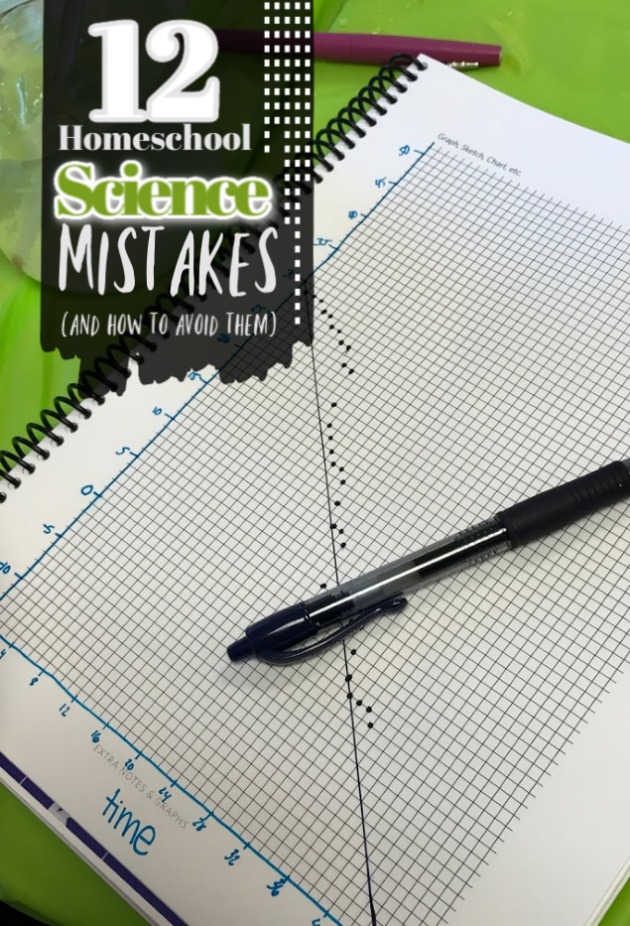
12 Homeschool Science Mistakes to Avoid

January 20, 2020 by Anne Marie 9 Comments

Homeschool science is a challenge for busy families because it may not be as easy to teach as things like the ABC’s and 123’s. But while science concepts and lab projects may seem daunting to parents and children alike, it doesn’t have to be a hurdle in the education process. In fact, having a strong science foundation gains importance with each passing year in our modern world.

Today I want to share with you a very informative article by Greg Landry, who is definitely an expert in this regard. Greg will steer you around the most common mistakes, making a your homeschool science experience much more enjoyable and effective!


This post is sponsored by College Prep Science, copyright 2020 

As homeschooling parents, we give our children so many advantages as they move into the middle and high school grades, and then to college. But, I believe there is one area where we can significantly improve the way we prepare them. That area is science.

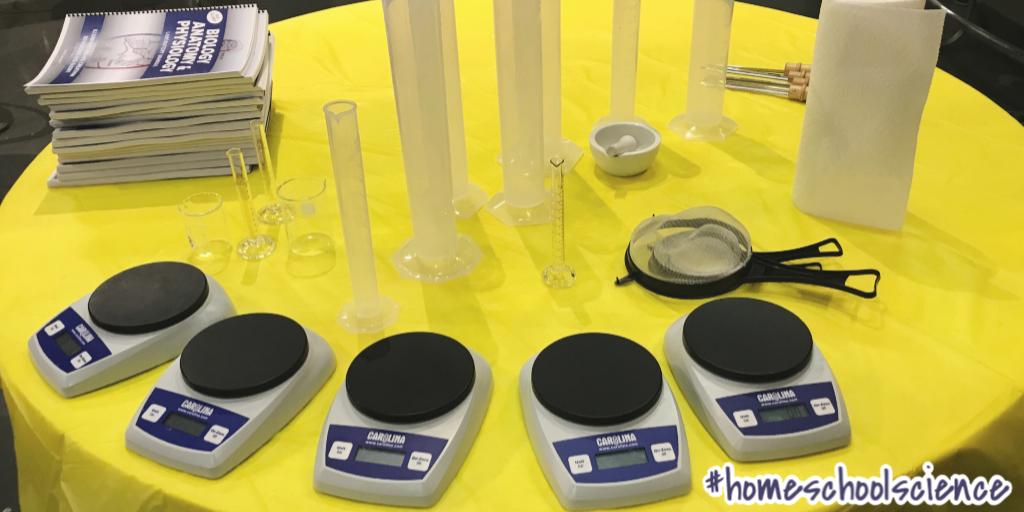
Having taught science to several thousand homeschooling and college students over the past 20+ years, several things stand out to me. I’ve put together a list of 12 homeschool science mistakes and 12 concrete steps we can take to better prepare our budding scientists.

Mistake #1 – Not starting to formally teach science early enough.

Start formally teaching science by the sixth grade. Students need the development and experience that happens in those three years (sixth, seventh, and eighth grade) to prepare them for high school level homeschool science.

Mistake #2 – Generalizing the names for, and thus the way we teach, science.

Call it Biology, Chemistry, Physics, etc. and not “General Science”, “Physical Science”, etc., even in the young grades. Doing this virtually eliminates the intimidation that comes with “Physics” etc. in the high school years and clarifies what you’re teaching in the middle grades.

For example, at College Prep Science, rather than a homeschool year of “Physical Science,” we teach a semester of “Pre-Physics” and a semester of “Pre-Chemistry.” Rather than a homeschool year of “Life Science,” we teach a semester of “Pre-Biology” and a semester of “Pre-Anatomy and Physiology.”

Mistake #3 – Not doing enough testing.

Testing in the sciences prepares our students for the rigors of high school level homeschool science, college science, standardized testing, and assures that they are learning the material and how to take tests. Of course, it should be age-appropriate, but we should be testing.

Mistake #4 – Not doing timed tests.

I know that very few homeschooling families give their students timed tests and I think we are doing them a disservice. Gently beginning timed homeschool science tests in the middle grades gives students confidence, eliminates the anxiety associated with timed tests and trains them to do well on standardized tests and on timed tests in college. 

​Start gently in the middle grades and slowly progress from there. For example, if you’re giving a student a 15 question test that you think will take them about 10 minutes to complete, tell them they have 25 minutes to take it. When they finish with plenty of time to spare it gives them confidence and relieves anxiety. The amount of extra time you give can be altered as they get older. Students actually perform better on timed tests because they are focused on the test – knowing they have to work steadily. I always tell students, “If you are prepared and work steadily you will have plenty of time to finish this test.”

Mistake #5 – Teaching science year-round.

I know that many parents are proponents of year-round school (no summer break), but I believe it’s actually counter-productive. From experience with thousands of students, I believe that students need to know they can work hard for a prescribed period of time and then have a total break from classes for a while.

Mistake #6 – Not starting the high school sciences early enough.

I know it’s easy to put off starting the high school sciences, but it’s important, especially if the students may be a college science major. Critical decisions should be made going into 8th grade. The critical factor is being ready for standardized testing and being able to fit in the needed sciences in the high school years. High school Biology should be taken in the 9th grade for most students and in the 8th grade for very capable students who will likely be science majors.

Mistake #7 – Not beginning to take the ACT early enough.

Success on this standardized test is critical for college admissions and plays a direct role in how much financial aid a student will receive. Taking these tests twice per year beginning in 9th grade gives students experience and confidence which enables them to do well when they take this test for the final time in 11th or 12th grade. See my article on this topic, “6 Reasons to Ditch the SAT and Laser Focus on the ACT.”

Mistake #8 – Not specifically preparing to take the “Science Reasoning” section of the ACT.

Homeschooled students score lower on this section of the ACT than on any other section. This is a section of the ACT that can be quite intimidating but can be mastered with preparation. It’s especially important if you are planning on a science major in college. See my article on this topic, “6 Reasons to Ditch the SAT and Laser Focus on the ACT.”

Mistake #9 – Not training students to write good lab reports.

As a college professor, I saw the pain of students who came in as science majors without good lab report writing skills and experience. Students get better at this with experience – there’s no substitute for that. Lab reports are simply the written record of the scientific method. It takes lots of practice to develop the skill needed to do well on these.

​Mistake #10 – Not creating a lab manual for every science class.

A lab manual is a collection of observations, data collection, and lab reports from a class. This gives students one place to neatly keep all of this information and gives them a sense of accomplishment. It’s impressive to have them lined-up on a shelf from all of their science classes. It’s also required by some states or umbrella groups for homeschoolers and some colleges want to see lab manuals as evidence of labs being completed.

Mistake #11 – Being squeamish on Creation.

Despite what you may hear in the media and elsewhere, God wrote the book on science. We need to boldly teach our students about God’s creation. Science and the world around us support biblical creation.

Mistake #12 – Not using graphing extensively.

Graphing, when done regularly through the middle and high school grades has a unique ability to develop critical thinking skills in students that not only benefit them in math, science, and academics in general, but also in life! We encourage families to have students construct one graph daily as part of their homeschooling day. They can graph anything. Let them run with it and you will be surprised at how creative they are. The resulting skills can be very beneficial.


​Homeschool dad, scientist, and former college professor, Greg Landry, offers live, online homeschool science classes, the Homeschool Mom’s Science Podcast, in-person two-day science lab intensives nationwide, freebies for homeschool moms, and homeschool print publications that students can be a part of.


Filed Under: Homeschooling

Reinforce Math Skills with IXL Learning + a Giveaway

December 13, 2019 by Anne Marie 11 Comments

Are you eager for your child to gain fluency and confidence when it comes to math? It can be especially challenging if you’re homeschooling, so today’s post focuses on some math resources we recently discovered from IXL.

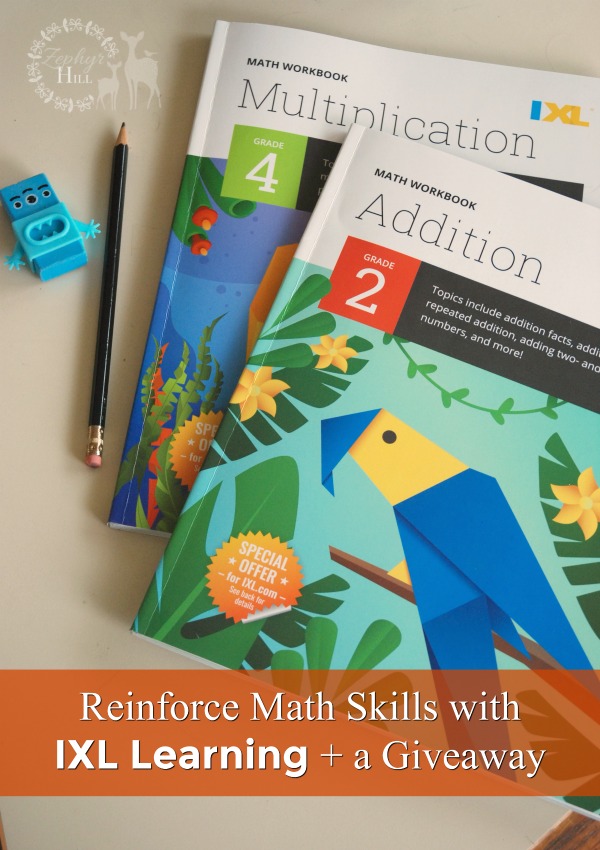
We received two math workbooks to try out from IXL Learning, a company that serves more than 7 million students worldwide and offers a personalized approach to education. There’s also a giveaway you can enter for your choice of a workbook from IXL!

  • Comprehensive K-12 curriculum
  • Immersive learning
  • Memberships for families, classrooms and school districts
  • Supplemental materials for your math courses

I’ve used these workbooks to reinforce what Samuel (4th grade) and Susanna (2nd grade) are learning in math this year. 

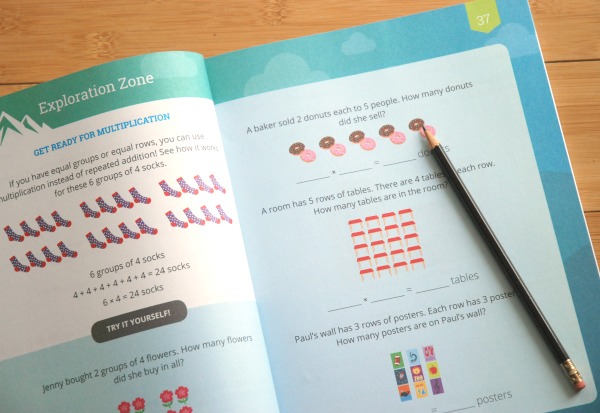
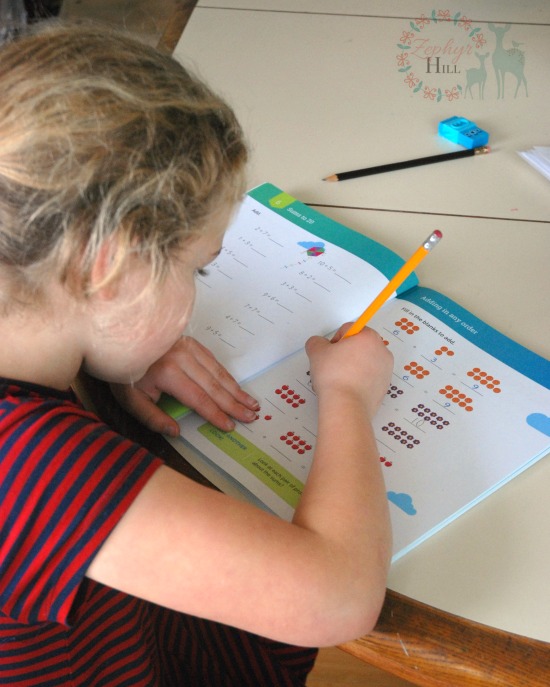
Addition Workbook, Grade 2 (112 pages) covers basic facts and progresses to adding 2-digit numbers. Later in the book, early multiplication concepts are introduced, building on the idea that it’s basically repeated addition. IXL Math Work Book: Grade 2 Addition is available on Amazon for $9.77.

Susanna, of course, loves the full-color pages, and I like that the activities aren’t repetitious or boring. Yes, there’s a place for drilling and memorization in math, but the IXL workbooks offer a welcome diversion while still being very educational.

There aren’t a lot of problems to work out on each page, which is great since this is merely a supplemental workbook.

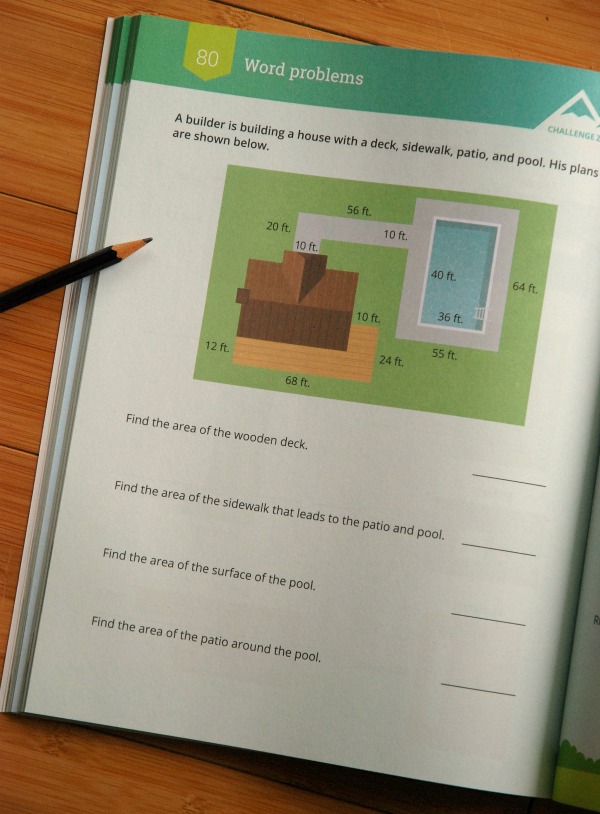
Multiplication Workbook, Grade 4 (112 pages) covers all the basic facts and then progresses to multi-digit multiplication. Also included are practical applications like using multiplication skills to answer real-life word problems and solve basic equations. IXL Math Work Book: Grade 4 Multiplication is available on Amazon for $9.17.

Answer keys are included at the backs of both workbooks.

If I could offer two suggestions for improvement, they would be: (1) use spiral binding so the books lie flat, and (2) perforate the pages so you can easily tear them out if needed.

Giveaway: And now here’s how you can enter to win a free workbook from IXL Learning! Just fill out the entry form below. Also, leave a comment and let me know what math skills your child is trying to master right now. IXL Learning has resources at their website for over 4,000 different math skills – including geometry and alegebra and calculus! 


a Rafflecopter giveaway

Filed Under: Giveaways, Homeschooling

A Review of LIFEPAC’s Christian Grade 1 Science Curriculum

November 7, 2019 by Anne Marie Leave a Comment

Working through a science curriculum for young children often takes a back seat to core subjects like math and language arts when you’re homeschooling, but it doesn’t have to be that way. Little ones can and should learn about the wonderful world around them, and LIFEPAC makes that accessible and fun.

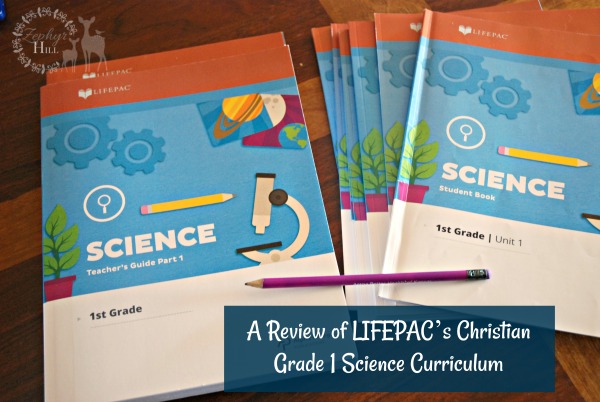
In September,  Alpha Omega Publications gave us the chance to try their Grade 1 Science Kit for Erik. Alpha Omega’s LIFEPAC series is an award-winning, Christian program with a parent and child focused approached that has defined their company since 1977.

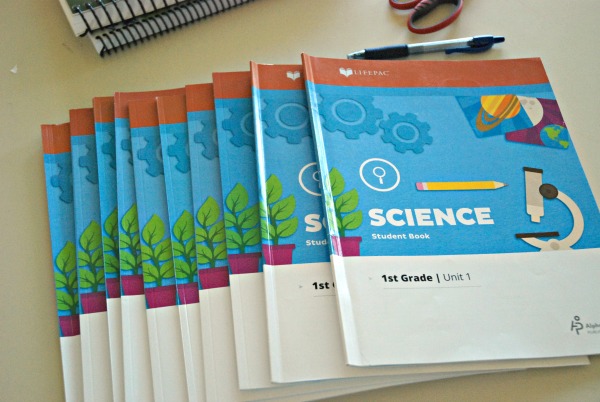
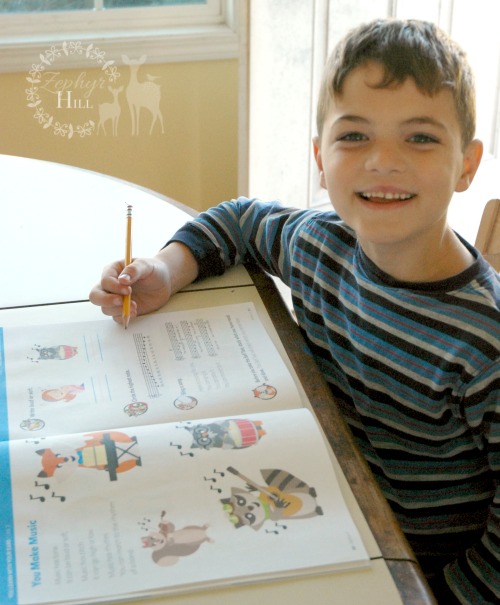
Like the math program we reviewed last year, LIFEPAC’s science series consists of full-color, worktexts and a teacher’s guide. There are 10 student worktexts and at first glance, you might ask “why so many books?” But each is only about 25-30 pages, giving your child the feeling of completing multiple units, and sparing you both the inconvenience of lugging around a big heavy textbook.

The Grade 1 Science Set includes the teacher manuals (part 1 and 2), plus 10 consumable student workbooks in full color. The kit retails for $99.95 and provides a whole year’s worth of science education and experimentation.

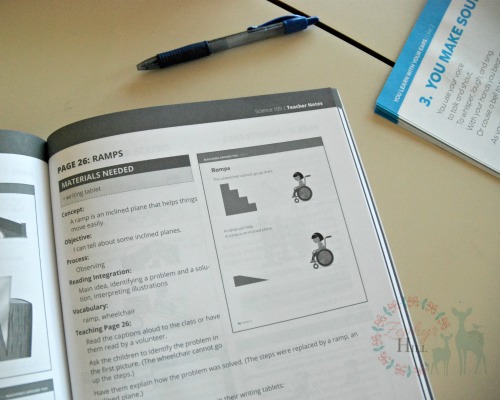
Workbooks can also be purchased separately for $7.50 if there are certain subjects you’re more interested in than others and if you don’t want to spend money on the teacher guides (any parent should be able to administer the program without a manual). Here’s a sample page showing suggestions for teaching the lesson on ramps:

I find Alpha Omega’s prices to be fair and comparable to other similar programs with student and teacher materials bundled together.

LIFEPAC uses the traditional approach of touching lightly on a variety of topics, rather than spending a lot of time on any one concept. If you find that your child gets really excited about one of the lessons, consider putting that unit on hold. Explore the topic in depth by checking out library books or going on a field trip.

Topics covered in these 10 units include:

  • The human body
  • Animals and plants
  • Energy and machines
  • Health

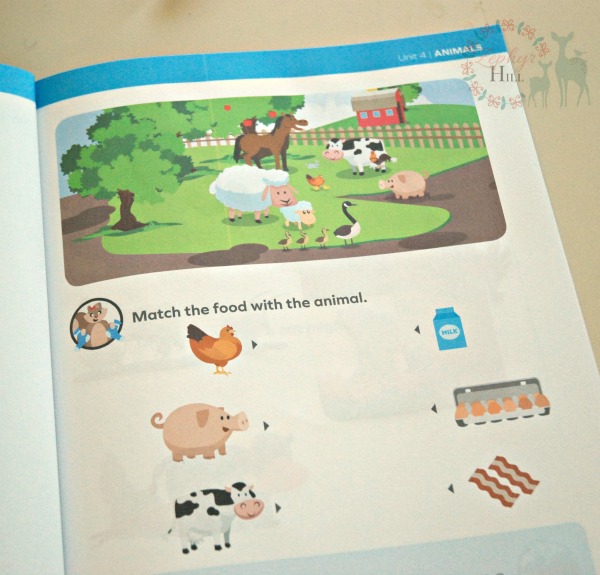
Lessons are manageable and pleasant to work through, with a page or two of teaching and then another page or so of written work. Depending on your child’s age and skill level, he or she may already be very familiar with the material. For example, early units (1 through 5) cover such basic concepts ranging from colors to sizes to animals on a farm; most first graders already understand these concepts well. I would suggest skipping these units and/or pages, and moving on to things that will challenge your child. Or consider moving up a grade level, because overall I would say the difficulty level of this kit is very low.

There’s a lab kit that you can purchase for $23.95 to reinforce the lessons, but it’s optional.

As a Christian publisher, Alpha Omega weaves a biblical worldview throughout its books. LIFEPAC Science Grade 1 gives due credit to God for His creation and encourages children to appreciate and explore its wonder.

In conclusion, here are the pros and cons of LIFEPAC’s Grade 1 Science Kit:

Pros

  • Full-color workbooks with appealing images and easy-to-understand text.
  • Workbooks are lightweight and not lengthy, and your child will get to “complete” 10 of them in the course of a year.
  • Affordable
  • Christian worldview

Cons

  • May not be challenging enough
  • Doesn’t go into depth on any particular topic

Alpha Omega offers a full homeschool curriculum for grades 1-12, including Bible and electives. There are print-based, computer-based and online components. You can also check out the accredited Alpha Omega online academy.


Shop Alpha Omega homeschool curricula online
You can also follow on social media:

Facebook

Twitter

Pinterest

Instagram

What do you think of Alpha Omega’s science materials? What are your child’s favorite scientific topics?

Filed Under: Homeschooling Tagged With: Alpha Omega review, Grade 1 Science, homeschool review, homeschool science, science curriculum, science workbook

6 More Ideas for Getting Homeschool Clutter Under Control

October 9, 2019 by Anne Marie 8 Comments

As the year gets underway, parents learn that homeschooling can quickly get messy. Have you ever wanted to peer into someone else’s homeschool for inspiration about how to better organize? Although everyone learns in a different way, and uses different places in the home, these tips are helpful for any setup.

Keeping clutter under control helps keep your attitude more positive, and it fosters a pleasant learning environment for your family.

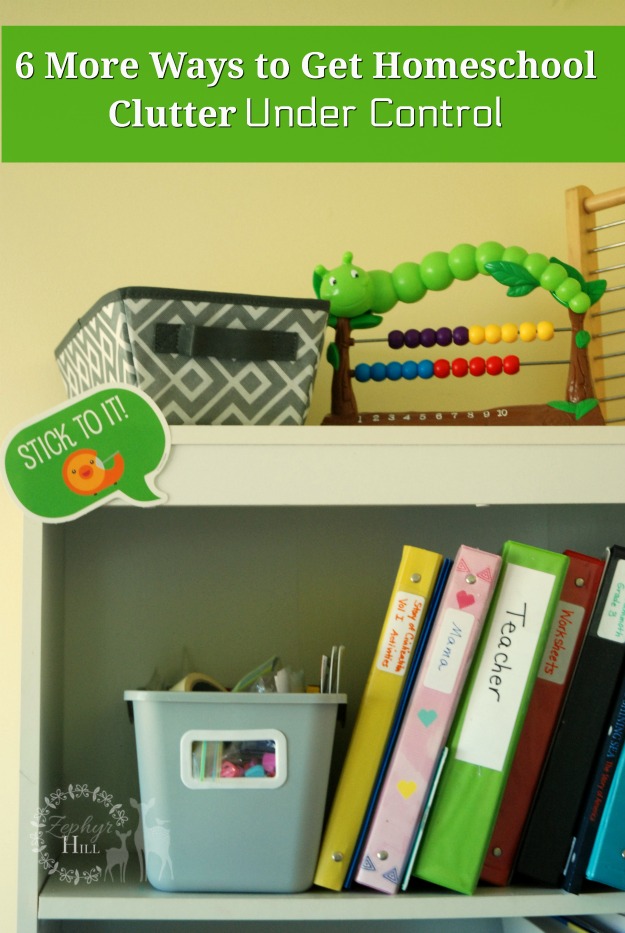
# 1 Shelves and Baskets

You don’t have to buy expensive furniture. You can get bookcases, shelves, baskets and bins on a low budget. Check yard sales and online sites like Facebook Marketplace and Craigslist. Repurpose shoeboxes and shipping boxes, covering them with gift wrap or wallpaper for a nice aesthetic.

The beauty of containers is that they cut down the visual clutter by storing a variety of things behind one solid surface. Here are the types of things you can corral in containers:

  • Pens, pencils, crayons and erasers
  • Tape and scissors
  • Craft supplies
  • Math manipulatives and tools (compass, protractor, calculator, etc)
  • Small office supplies (clips, post-it notes, rubber bands, etc)
  • Dry erase markers and erasers

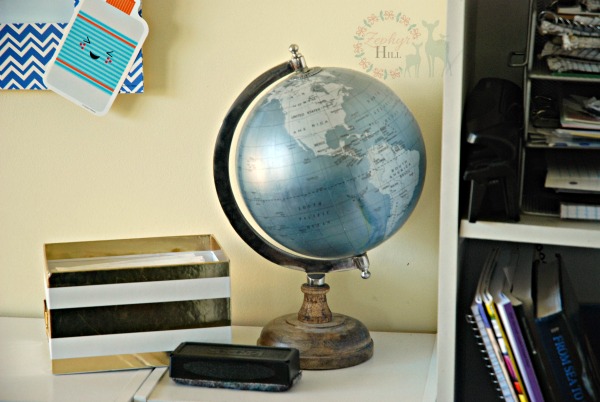
With everything that you don’t want to look at squirreled away into a box, be sure to put something on the desk or shelf that you do want to look at – perhaps a globe or a seasonal centerpiece.

#2 Table or Desk

And the more drawers the better! I like that vintage/antique tables add character to a homeschool room. You can look for the right one that fits your budget, and remember that a cheap bottle of paint can revive a worn-out piece.

Use the deeper drawers for large items like books, papers and notebooks. Little drawers are nice for those things you don’t have a bin or basket for. As the teacher, I have one drawer reserved just for my things.

Consider a drawer for “Quiet Time Toys.” Younger children who aren’t schooling have to be kept occupied and they will have fun amusing themselves with things in this drawer. Some ideas : board books, blocks, play dough and tiny plush toys. You can find all these things for pennies at garage sales.

#3 Multi-Functional Furniture

A lot of families have to deal with limited space, so it helps to have dual-purpose furniture. I know many mothers who use their kitchen island or breakfast table as the homeschool hub. It helps to have shelves or drawers nearby so schoolbooks can be stowed away when it’s meal time.

Consider setting up a large table in another room such as your den, playroom, basement or laundry room. When your children aren’t working on school, it can be used for other everyday purposes.

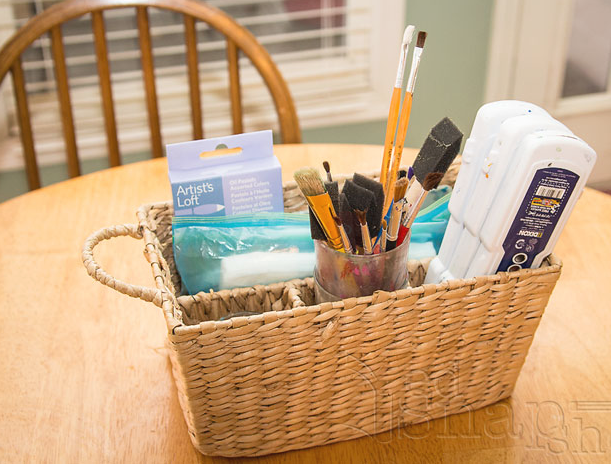
#4 Caddies

A caddy don’t right can actually sit right in the middle of the table permanently, looking good and within easy reach. Art supplies and writing utensils look very appealing nestled in a utensil basket like the one pictured above. Choose to stow the tools your students will be using daily.

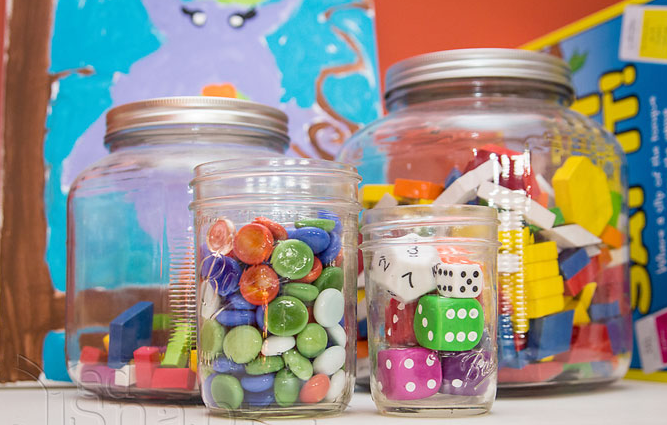
#5 Glass Jars

I use glass jars for everything – canning, glasses for drinking, baby bottles, and storage. They are ideal for school, too. Everyone can see what’s in the jar, and there are lots of sizes to choose from. Perfect for storing, beads and counters and erasers, clear jars also make a colorful and fun display that will cheer up your homeschool and become a part of the room decor.

#6 Magazine Holders

I have tried different methods, but this year I decided that there’s no better or effective way to store the large volume of taller books and papers than with magazine holders. I first made my own by repurposing priority shipping boxes and wrapping paper, but buying a set of sturdy plastic ones is a good investment for the future. You can sort books by topic, by grade or by student. Each child in my family has a holder (or two).

Got Ideas? 

If you’ve got homeschool organizing tips to share, I’d love to hear them. Let me know in a comment!


Filed Under: Homeschooling

  • « Previous Page
  • 1
  • …
  • 3
  • 4
  • 5
  • 6
  • 7
  • …
  • 11
  • Next Page »

SOCIAL MEDIA

Newly Published

  • The Coop Upgrade Nobody Talks About Until It’s Too Late
  • Ignore the Radio Ads About Life Insurance, But Please Read This Post
  • Do Catholic Parents Have to Choose a Saint Name for Their Baby?
  • The BEST and Most Comprehensive Baby Name Books for Parents
  • Educational Games to Enjoy With Your Children

Popular Posts

  • Tiny Love Bouncer Review
  • Sweet Pea AI3 One-Size Diaper Review & Giveaway
  • 6 Common Homeschooling Mistakes to Avoid
  • Sweet Pea Bamboo AIO and Pail Liner Review & Giveaway
  • How to Study (and Teach) at Home With Less Distraction

Copyright © 2026 · Zephyr Hill Blog · Design by Albemarle PR

Copyright © 2026 · Albemarle PR - Hannah Template on Genesis Framework · WordPress · Log in