Zephyr Hill

A Family Blog

Header Menu

  • Home
  • Contact Me
  • Terms / Privacy
  • Homeschooling
  • Faith and Family
  • Book Reviews
  • Cloth Diapers
  • Pets

How We Broke the Pacifier Habit

September 11, 2013 by Anne Marie 25 Comments

Catherine, my second oldest, was the only baby that would ever take a pacifier. By a year old, she was almost completely reliant on it. The “paci” was a familiar friend at play time, nap time and bed time, and car trips. Thankfully, it was easier to break the pacifier habit than it was the thumb-sucking habit.

Unlike a thumb, which is part of a child’s body, a pacifier is merely an object. That means mama can control it! (Yeah!)

To break the habit for good, I lost Catherine’s three pacifiers – on purpose. At just over a year old, she was capable of understanding the simple concept of something being lost. “All gone!” I announced one day. “The paci is all gone! Where is it?” I feigned genuine despair and Catherine fell for the masquerade. We hunted around the house for a while. We looked under furniture. Checked her crib and the toy basket. The pacifiers had vanished (cough cough)!

There was some fussing, but not a lot. Basically, when Catherine started to cry or whine for the pacifier, I would simply throw my hands up and say again “The paci is all gone? Where is it?” She would stop crying and look around. I would spend another minute or two “looking” for it. The drama created by searching for the lost binky was a great distraction, and it completely banished the tears. After looking for a while, Catherine would get bored and go back to whatever she was doing before.

This went on for a few days, and she simply forgot about her pacifiers. I don’t remember where I hid them, but I did throw them away when I saw she was over it for good. I think this approach worked pretty well for two reasons: timing and temperament. Catherine was just over a year old, so while pacifier-sucking was a habit, it wasn’t as deeply ingrained as it could have been. Waiting until she was a toddler might have made it tougher.

Secondly, Catherine is a sanguine child. A hallmark of this particular temperament is that the sanguine is always looking for fun and new things, and is therefore easily distracted. They are quicker to forget hurts, worries and problems. (Speaking of temperaments….I’m going to be doing a post on this shortly. It’s a fascinating subject which dates back to antiquity, but is grounded in some very simple truths about human personalities!)

But back to pacifiers…

You could try my trick and see if it works. And starting to break the habit at around a year old (or less) is ideal because they are starting to explore and you can get them interested in other things besides the pacifier.

Two other methods I’ve heard that work well are (a) asking your child to give away the pacifier (to Santa, the Tooth Fairy, another baby, etc.) and (b) weaning them away slowly (take away the binky at play time, then nap time and eliminate bed time last).

I know there are those who say “Children will give up the pacifier on their own. Why deny them a comfort measure?” My answer to that is very simple. Prolonged pacifier use, like prolonged thumb-sucking, can cause tooth and mouth problems. This wouldn’t happen until they are 4 or older, but that also means the habit will be deep set and harder to break. Once again, after dealing with the thumb-sucking issue I am a big advocate of catching potential problems early on.

Feel free to share your binky stories below!



Filed Under: Faith and Family Tagged With: breaking the pacifier habit, getting rid of pacifiers, getting rid of the binky, pacifier speech development, pacifier tooth problems

How Our Son Stopped Sucking His Thumb

September 4, 2013 by Anne Marie 24 Comments

Do you have a late thumb-sucker?

Joseph is the oldest of our seven children. He began sucking his thumb at 4 months of age, and continued until he was 8 years old. That was a long enough time for us to actually consult an orthodontist because we noticed that his top front teeth were being pushed forward from the pressure of his thumb.

We tried everything to break him of the habit. I Googled every trick in the book, but none of them worked for us. What many parents fail to realize is just how strong a thumb-sucking habit can be. It is a major source of comfort for many children and the older they get, the harder it can be to let it go. Now add the fact that sucking is an inborn instinct, and that the thumb is part of your child’s body (you can’t remove it or hide it like a pacifier), and you have a recipe for a mighty struggle.

So what finally broke the habit? Going to see the orthodontist. He didn’t do anything magical or terribly expensive. In fact, we went to his office twice and he never charged us a dime (the man is going to get ALL my business if we ever DO need dental work).

What the orthodontist provided was the gravitas of a trusted authority figure, plus accountability, and both of these things from an unbiased third party. The mere fact of going to the doctor and having a thorough interview and exam put in Joseph’s mind the idea that this was something very important. He knew that we were all getting really serious about stopping the habit. This definitely set the stage for success.

The doctor told me that Joseph’s teeth were not extended too far out; if he quit very soon, then the damage might actually be remedied by the natural pressure of his lips pushing back. If he didn’t quit….Joseph would probably need braces.

Dr. Edmonds then gave Joseph a great little pep talk. It went something like this: “Joseph, I’m going to ask you to stop sucking your thumb for a few days. I’m going to put this Band-Aid around your thumb to help you remember what I’ve asked of you.” He paused and wrapped a bright neon bandage around the beloved appendage.

And then he continued. “Sometimes you’ll want to suck your thumb really badly. I know it’s going to be hard. You’ll have two choices. Look at that bandage and think about what Dr. Edmonds asked of you and tell yourself not to suck it. Or rip that bandage off and suck it anyway.”

Joseph was listening with rapt attention.

Then Dr. Edmonds said, “The first few times you choose not to suck your thumb, it’s going to be difficult. But I promise you it will get easier. And if you come back in a month and your mama tells me that you’re not sucking your thumb at all anymore, I have a big box of toys for you to pick something out of.”

And then the two of them shook hands, like men do when they strike a bargain.

We went home and the trial period began. After three days, Joseph quit the habit. He never sucked his thumb again. You can bet that one very proud and grateful mother walked into the orthodontist’s office a month later. Joseph was on a high from his success…and from the neat toy he got out of that box!

OLYMPUS DIGITAL CAMERA

I would recommend this type of method for any family dealing with prolonged thumb-sucking. And I’m not saying you have to go to the doctor. The key to this method was finding someone authoritative (and liked by the child) besides mama or daddy to “make a deal” with the child. It could be a local fireman or the lady who cuts hair at your local salon. Find someone that your child admires and looks up to; this is crucial because it provides the motivation for those moments of temptation. They will want to say NO because it’s even harder to go back to that person and tell them you failed.

Have you had a thumb-sucker that held on to the habit for years? What worked for you?

Filed Under: Faith and Family Tagged With: how to stop thumb sucking habit, stop thumb sucking, thumb sucking habit, thumb sucking orthodontist, thumb sucking tooth problems

Don’t Let Fall and Winter Stop You from Gardening

August 10, 2013 by Anne Marie 15 Comments

We moved into our new house this spring, and because of all the hustle and bustle there was no time for a big family garden. All we were able to cultivate was a raised bed with a few tomatoes and some parsley.

Both are growing well, and it’s nice to have such a tiny little garden to tend to for a change, but then again – I do like to have more things to harvest at the end of summer. Who doesn’t? But we’ll have to wait until the next growing season for bright summer squash and zucchini, plump melons and crispy sweet corn.

Jeremiah did find time to go ahead and till up the garden plot, and he built a nice little compost pile.

Since we’re fairly sure this land was heavily farmed before the house was built, we wanted to give our newly tilled plot a little boost. Jeremiah bought the “Fall Green Manure Mix” from Johnny Seeds for nitrogen fixation. Ideal for planting in late summer or fall, this seed mix contains rye, field peas, rye grass, clover and vetch. It will help protect against erosion this winter and provide good soil cover.

When my tomatoes give out, I’ll be planting some cool weather veggies like kale and spinach. Dark leafy greens thrive in cool weather, and some (like Mache) will even grow in the snow! Kale and spinach are perfect for making hearty and nutritious soups for crisp fall and winter nights.

Fall has always been an ideal time for planting bulbs, so if you love lilies, tulips, irises and other beauties, this is a good time to get them in the ground and establishing good roots. If you’re looking for low-maintenance perennials to fill up a bed, my favorites are hosta and sedum. Other reliable varieties: Yarrow, Russian sage, coneflowers and peonies.

It’s a great time to work on landscape and design, too. With coolers temperatures, you don’t have to worry about sweating buckets while hauling rocks, stones and big bags of mulch.

If you’re still not convinced, here are a few great reasons to keep on gardening, even after summer’s over:

  • Plant nurseries start slashing their prices on both plants and tools
  • All those leaves that are falling to the ground make great compost
  • Look for old or discounted straw bales, or hit up people for decorative bales that don’t look good anymore; they make great mulch or compost
  • There’s less work and maintenance required with fall crops, and it feels so much nicer outside!
What’s in your garden this summer? Are you planting anything this fall?


Filed Under: Faith and Family Tagged With: cool weather plants, easy gardening, fall gardening, winter gardening

I Breastfed 7 Children…and Lived to Tell About It

August 1, 2013 by Anne Marie 33 Comments

For me, breastfeeding has been quite a roller coaster ride. I’ve nursed all 7 of my children….but our experiences have been all over the map. I’ve endured all the troubles, and the triumphs, that nursing can bring along.

Here’s the full dossier:

Joseph was my first baby. I read a lot about breastfeeding during pregnancy and was enthusiastic and (so I thought) well-educated. But the antibiotics I was given for my c-section led to a massive candida/yeast infection in my breasts and the pain was excruciating. Plus, Joseph came early and was small, so he struggled mightily with correct latch. Things just went from bad to worse, and Jeremiah and I worried that Joseph wasn’t getting enough to eat. His weight was barely inching up the scales. After 2 months of prescription medication, pain, crying and constant weigh-ins, the stress was just too much. I switched to formula. For many in breastfeeding circles, this classifies as a failure. Not to me! I was thrilled with those warm bottles of Enfamil; feedings were now happy, quiet and satisfying times. It was pure bliss to see my infant son getting nice and chubby. For me, the horrible pains and burning sensations were gone. But I was sad that breastfeeding hadn’t worked out as planned. I figured that with this experience under my belt, the next time would be easier.

Catherine came along the following year, my first successful VBAC! She was a chubby, rosy-cheeked baby, and eager to nurse. Although the first week was extremely painful for me, I reasoned that it was just the toughening-up phase. But the pain didn’t go away. I started to crack and bleed. One morning I awoke feeling like the Illinois Central had run over my body. When my husband found me shivering and shaking in bed, he knew it was time to get me to the hospital. The news wasn’t good: I had a severe case of mastitis AND a post-delivery uterine infection to boot. Worse still, the military hospital would not allow me to room in with week-old Catherine. I was such a greenhorn, and so desperately ill, I didn’t have the gumption to fight back. So I began pumping milk (which hurt like heck because of the infection) and sending it home to my newborn. After nearly a week in the hospital on high-powered antibiotics, guess what happened? Another YEAST infection. I was feeling pretty low at that point, and had no desire to go through more pain and more medication. I just wanted to be well, get back home and feed by baby girl without tears. “Maybe I’m just not meant to nurse a baby,” I thought. So Catherine went on formula at just 2 weeks of age.

Once again, I was really disappointed about our nursing plans going awry.

Margaret is the beautiful little baby we lost in 2007. Her problems with nursing were very unique. Because of severe heart defects and low oxygen levels, breastfeeding for her was like a brisk job. She just couldn’t do it without becoming exhausted. Although I pumped for five months, there still were not enough calories in my breast milk to sustain her and promote weight gain, so high-calorie formula powder was added to what I pumped. I thank God for that formula that helped to nourish Margaret during her short life. God called her home just before she turned six months, but I was grateful for being able to provide some of my little girl’s milk until she died. Still, amidst all the grief of losing our little girl, there was a twinge of sadness in my heart because I still felt the experience of nursing one of my children long term was out of reach.

Benjamin is what mothers call a Rainbow Baby. God sent him after the storm of grief that followed Margaret’s passing. Call it stubbornness or sheer force of will, but I steeled myself physically for the ordeal and nursed him right through the horrible pain of yet another yeast infection (caused, as before, by antibiotics). If you’ve never experienced candida while nursing, let’s just say I wouldn’t wish it on my worst enemy. The stabbing pains are felt deep in the breast and when baby latches on it feels like hot knives are stabbing your skin. Multiply this by 8-10 feedings a day for an insight into my misery. It took nearly 4 months to completely clear the infection up; but after that, we reached the summit of the mountain. By that I mean that Benjamin was breastfed until he was 14 months old. Something I had waited 6 years for!

It was actually difficult to wean him because I treasured that time so much…BUT I became pregnant again and that sort of solved that dilemma for me. 🙂

Samuel came along next and I felt ready for anything. My first decision was to decline antibiotics during labor even though I had tested positive for Group B strep. I did LOTS of research and was 100% happy with the outcome; my midwife supported me wholeheartedly. After 4 babies, I had learned my pattern: antibiotics=yeast. We got through the first few weeks of toughening up, and newborn Samuel and I were soon nursing pros. Because of an early return to fertility and a surprise pregnancy test at 7 months postpartum, he weaned at 11 months.

Susanna was born and the story reads almost exactly the same. Once again, I tested positive for Group B strep, and once again I said “No thanks!” to the IV. So glad I did! No antibiotics, no yeast and no pain! Breastfeeding went very smoothly and once again we were happily surprised by a Dollar Store test at about 7 or 8 months postpartum. Susanna weaned before her first birthday (I’ve learned that after about 3 months into a pregnancy, my milk supply changes and dwindles to almost nothing).

Erik is number seven and he nurses like a trooper. Besides the initial soreness that always happens in the first month (more on this below), we made it through and have a good and comfortable nursing relationship now.

UPDATE – Added my experiences with Ingrid (#8) and Mary Kate (#9) below.

Ingrid was born in 2014 and was yet another unique experience. She contracted pneumonia at just one day old and had to be admitted to the NICU for one week. This delayed nursing, and caused me some extra pain (from engorgement) and anxiety. For the first days, doctor’s orders were nothing by mouth at all, which was very frustrating, but we had to trust it was for the best since her respirations were higher than normal. Before the first week was out, I was allowed to hold her and attempt some short nursing sessions, which she tolerated well. At 8 days old, her antibiotics were done and she came home.

And then I went through the typical first month pain. This always happens to me, even with a good latch. It’s worse than the normal soreness or toughening up. My midwife finally told me, “You have very sensitive skin, and combined with the small mouth of a newborn that can only open so wide, the pain is going to persist until baby grows bigger.”

And that’s exactly what happens. Sometime after the first month, I notice that nursing doesn’t hurt so much anymore. By three months, I’m pain free.

Mary Kate was my first home birth! She was also my biggest baby at 9 pounds. Yet the month-long soreness had to be dealt with yet again.

I deal with the early pain of nursing by using a breast pump when feeding my baby is just too excruciating, or when the skin is cracked and/or bleeding. Just 4-6 hours of relief can make a lot of difference in terms of physical healing, and emotional well being. Although a manual pump is fine, several years ago I invested in a good double electric Medela and never have regretted that purchase. I’ve also lent it out to friends, and am glad to have the resource.

I’ve also learned that you don’t really need to slather yourself with ointments and creams to heal; sometimes just being exposed to air is enough.

There are many people out there who believe so strongly in breastfeeding that they would scale Mount Everest with a baby strapped to their back if that was necessary to get it done.

I’m not one of those people. While I did persevere through some difficulties, there were definitely some hurdles that I personally felt were too overwhelming, and NOT worth tackling just so I could say I breastfed. So you won’t read my story in a mothering magazine with a headline like “If I can do it, anyone can!” There are many reasons why some mothers can’t or don’t breastfeed, and it’s not my place to approve or disapprove. A happy, nourished, loved child is a blessing that I will celebrate with any mother any day!

That being said, breastfeeding is undeniably a baby’s ideal food, so I’m a huge believer in support and advocacy. Speaking of, do you have questions about nursing? Need some encouragement? Want to get something off your chest? (Sorry for the bad joke….)

Just leave a comment or use the Contact Me tab above. I would love to help if I can, or just listen (if that’s all you need). 


Filed Under: Faith and Family Tagged With: breastfeeding challenges, candida infection breastfeeding, thrush breastfeeding, world breastfeeding week

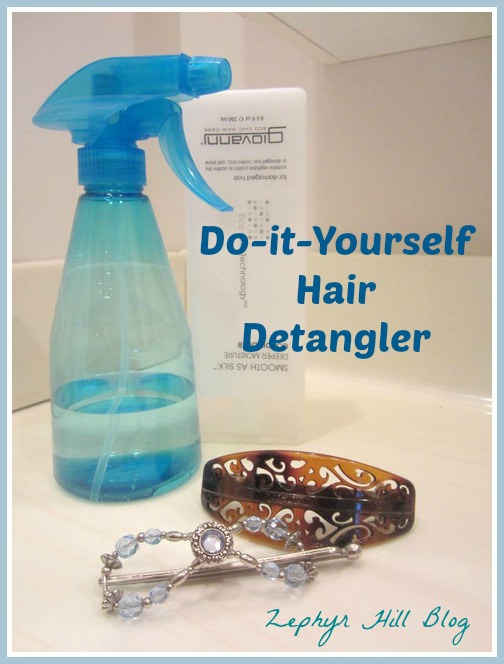
Make Your Own Hair Detangler and Save Money

July 30, 2013 by Anne Marie 13 Comments

Ever since I finished reading Curly Girl by Lorraine Massey last month, I’ve been dealing with my wavy hair differently. No more constant shampooing, no more wringing or brushing wet hair and no more wet cuts at the salon.

While searching for an alternative to the hair detangler I’m constantly buying for my daughter and myself, I discovered a do-it-yourself recipe that works just fine. While detangling sprays and creams aren’t expensive, the cost does add up at a couple of bucks a bottle. This homemade recipe is super cheap!

Here it is:

Basic Detangler Recipe

1/2 to 1 tsp. of conditioner of your choice
Warm water
Small spray bottle (which you can get for about one dollar)

Pour conditioner into bottle. Fill with water. Give it a good shake until both ingredients are mixed.

Look at the benefits:

  • Save money by using conditioner that you already have on hand, or use samples/freebies that you’ve received.
  • The ratio of water to conditioner can be adjusted to find what works best for you.
  • The recipe can be used on any type of hair, regardless of ethnicity.
I’ve also seen this recipe with a dash of olive oil added, but haven’t tried that myself. I wanted to keep it really simple.Another tip that was shared with me by a lady who grew up in the 50’s is to sleep on a satin or tricot pillowcase. She said this helps reduce tangling, bunching and breakage.

I’ve also read that a couple of tablespoons of apple cider vinegar mixed with water can act as a detangler in a pinch.

Do you have any tricks for dealing with tangled or dry hair?


Filed Under: Faith and Family

  • « Previous Page
  • 1
  • …
  • 24
  • 25
  • 26
  • 27
  • 28
  • …
  • 31
  • Next Page »

SOCIAL MEDIA

Newly Published

  • The Coop Upgrade Nobody Talks About Until It’s Too Late
  • Ignore the Radio Ads About Life Insurance, But Please Read This Post
  • Do Catholic Parents Have to Choose a Saint Name for Their Baby?
  • The BEST and Most Comprehensive Baby Name Books for Parents
  • Educational Games to Enjoy With Your Children

Popular Posts

  • My Home Birth Story: Full of Surprises
  • Organics by Ti Bamboo Flats Review & Giveaway
  • Home Schooling with Limited Space
  • 5 Ways to Handle Food Throwing and Messy Eating
  • Outside-the-Box, Delightful Gift Ideas for 2022

Copyright © 2026 · Zephyr Hill Blog · Design by Albemarle PR

Copyright © 2026 · Albemarle PR - Hannah Template on Genesis Framework · WordPress · Log in