Do not dry your diapers on high heat; it will damage the PUL fabric!
If you do not dry your PUL diapers on high heat, they might leak!
Cloth diaper advice can seem contradictory at times. Which of the above statements about PUL is true? I’ve been wondering about that for a long time, so I did a lot of research and asked questions of both manufacturers and home sewers.
Let’s start with the basics.
First of all, what is PUL? Also called polyurethane laminated fabric, “PUL” is basically just that: a poly knit that has been laminated with a clear, thin film of polyurethane to create a waterproof backing. It comes in different thicknesses (like 1 mil and 2 mil) and can be made of different components, but the basic concept is the same. PUL was first made for hospitals, which needed a reusable waterproof fabric that could withstand autoclaving (high heat steam sterilization). Naturally, this durable, washable and waterproof fabric found its way into the diaper market years later.
Is all PUL pretty much the same? No. Sarah, the highly experienced diaper-maker over at Wallypop, told me “A lot of the PUL out there these days is manufactured specifically for the diaper market…. There are numerous factories these days pumping out PUL – which is all slightly different, since there are several ways to adhere the layers together, and most major brands have their own PUL manufactured to their specifications.” [emphasis mine]. So be careful about recommendations to bleach or boil PUL since it was “made to withstand autoclaving” and other harsh treatment; unless you’ve checked with the manufacturer first, don’t assume you’ve got medical-grade PUL in your stash!
As you probably know already, diaper manufacturers generally advise against exposing PUL to high heat. They recommend wash cycles of no more than 130 degrees and to dry on low. They also discourage the use of the harsh “sanitize” cycle available on some washing machines.
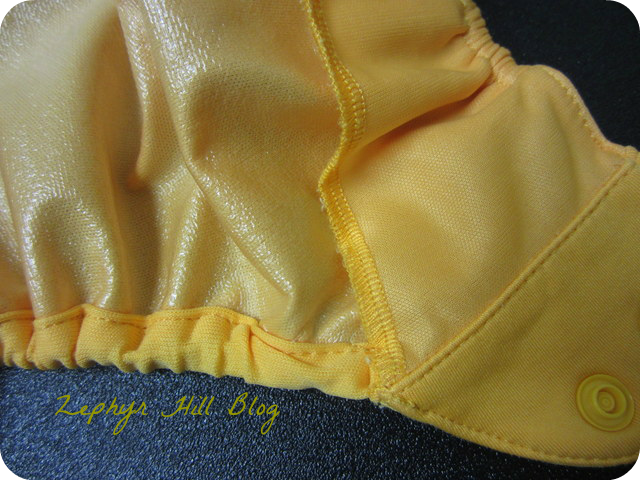
Then why the often-seen recommendation to dry a diaper on high heat to seal (or reseal) the PUL? It’s a theoretical answer to the question of tiny little holes that are present in the fabric.
When you sew PUL does it create holes? Yes, this is an undisputed fact. It’s a laminated, waterproof fabric and so it behaves differently than something like cotton, which has tiny fibers that meld and mesh back together.
So do the holes really need to be sealed up? Emma at Babyville Boutique (which makes PUL for home sewers) told me yes. “What the sealing does is close the needle holes from sewing the diapers. This is something you need to do anytime you sew with PUL and you want it to remain waterproof.” However, she did add “If you are purchasing premade PUL diapers and any other items, I would hope they have been pre-sealed. If not, then you cannot be sure they will not leak…The only way to close these holes is to put the article in a dryer and allow the laminate to shrink around the hole.” (emphasis mine) My friend, Kassie, who blogs at Homespun Aesthetic and also sews diapers in her spare time, told me “You’re supposed to use a ballpoint needle because they’re smaller. Many use their universal needle anyway (including me for my own diapers) because there’s no difference in the stitching or the way it sews for me.” This is why you’ll find WAHM’s recommending that diapers with PUL components be dried at least once on high heat before use.
Are factory-made covers already sealed for you? Not necessarily. I checked with my three favorite brands of diaper covers and here’s what they told me. Nancy from Sweet Pea Diapers said that their PUL components do not need to be sealed by the consumer. Cotton Babies (maker of bumGenius and Flip) also gave me an affirmative: “The fabric is pre-sealed.” But then they cautioned “Please do not put them in the dryer,” which is consistent with their online recommendation to line-dry covers. I should also mention that the Flip covers made by Cotton Babies have a second piece of fabric on the inside of the diaper to cover the holes made by snaps or hook and loop. When I asked Thirsties about their covers, the answer was different: “We do not pre-seal our PUL but we do recommend to dry on high occasionally to help re-seal the lamination.” My Thirsties worked great from day one, so I asked how that could be when they weren’t factory-sealed. Thirsties explained “We use a heat bonding method on our PUL, which is greener and provides a strong bond between the lamination and the fabric.”
Do you have to re-seal the PUL every so often to prevent leaks? I often see WAHM’s recommending this. And Thirsties was the only major brand I contacted that recommended this as well. The idea is that the tiny holes in your PUL will “open back up” with normal use, so you can re-seal it with a 15 minute tumble on high in the dryer. I have seen anecdotal evidence from both sides, so unfortunately the question remains unanswered. Moms will tell you their covers stopped leaking after they put them in the dryer on high heat; others swear they’ve never had a leak and their covers have been line dried from day one. The jury is out, and as far as I know, there isn’t any authoritative study on the subject.
I’ll close with one very important point that I hope this post has brought to light: it is extremely important to check with the manufacturer if you have questions about laundering or troubleshooting your diapers. I know some veteran cloth diapering moms and so-called experts might scoff at my advice, proclaiming “they’re just diapers, for crying out loud!” But the indisputable fact is, that each manufacturer has its own specifications when a diaper is made, and this has a lot to do with the care recommendations. Nor is all PUL fabric created equal. Garments have care labels for a good reason; no, it’s not just to “cover their tails” if a problem occurs. It’s their product, they designed it, so it pays to at least hear them out when it comes to care and use.
And now I’d love to hear your take on this issue! Do you line dry all your PUL diapers? Have you noticed any leaking, or has that never been an issue? Have you ever “fixed” leaky diapers by putting them in a hot dryer? Do you think it’s all a myth? Or are you a diaper maker with some experience to share? Leave your comments below!