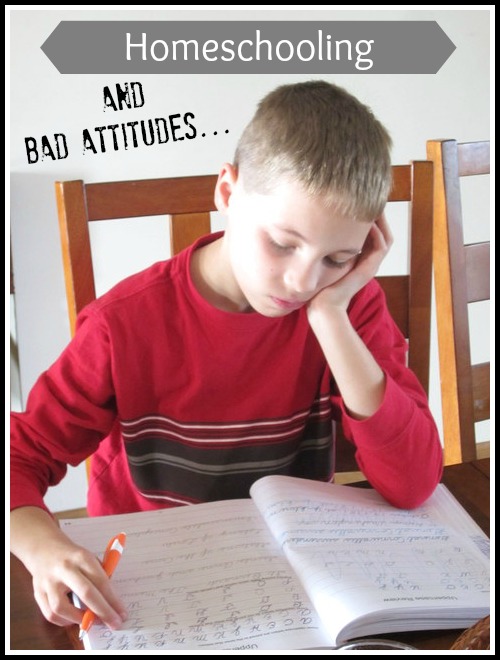
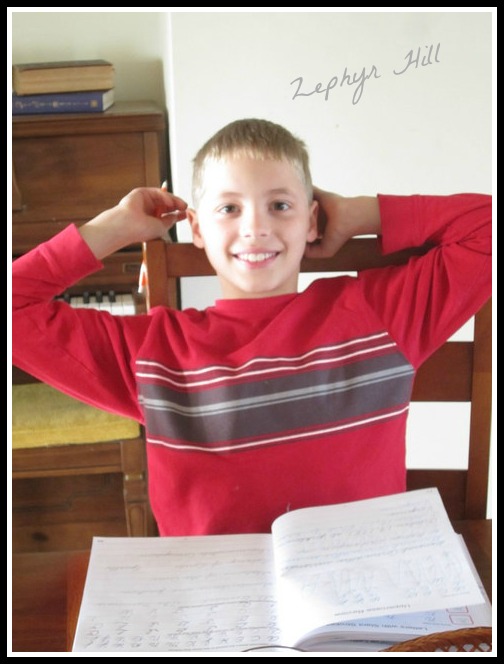
It’s almost inevitable. After staying home and doing school work with mama day after day, the telltale signs of a poor attitude will become evident. Your home schooled child will:
- Slump down in the chair and scowl at the books in front of him.
- Let out a deep and audible sigh as you start to teach, ask questions or explain an assignment.
- Deliberately look at something else other than the page right in front of him.
- Roll his eyes when you mention it’s test or quiz time.
- Indulge in a pity party if his grade is anything but an A.
- Proclaim loudly “I’m no good at this!” or “This is impossible!”
With 3 children currently homeschooling, I most definitely have to deal with complaining and shoddy attitudes from time to time. Whether it’s Catherine dragging her feet over math problems or Joseph bemoaning the rigors of spelling, a bad attitude can quickly derail progress. Even worse, it’s contagious! Mama starts to get down and complains to Daddy. Pretty soon, everyone is sick and tired of school! What to do?
You might try some of these tips, depending on your child’s temperament. And I would strongly caution you not to change your curriculum in hopes of curing an attitude problem. Rarely is this the issue! Buying a different book is quick and easy, but if the problem is in your child’s heart, or stems from your lack of discipline, then it will resurface again no matter which book they are working on.
Some possible solutions:
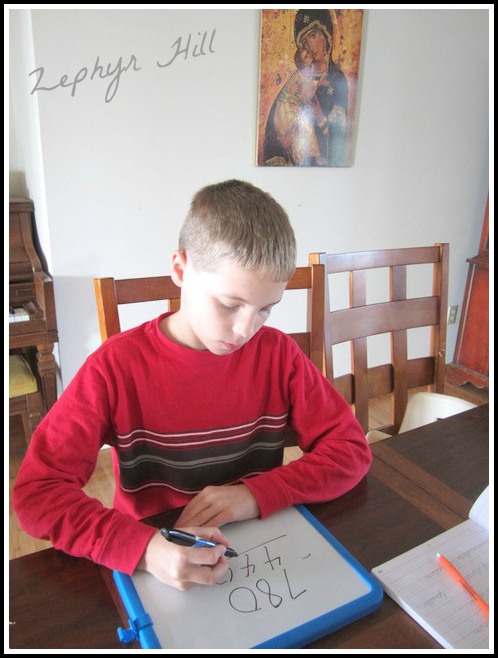
1. Let them work using a whiteboard and dry erase markers. I don’t know why, but this seems to do the trick sometimes. Perhaps it’s just because they get tired of bending over a piece of paper. Plus, it’s fun to write and erase. A change of scenery is always welcome.
2. Change the way you give assignments, but only temporarily. Every once in a while, I let the children take their spelling tests orally. Sometimes we will read our history lesson at a local cafe instead of at the school table. We can drill multiplication tables while in the van running errands. Be flexible and think outside the box, and your children won’t burnout so easily.
3. Consign the complainer to a corner. Say “You can come back to the table when you’re ready to do school work with a cheerful attitude.” Keep them in your eyesight (don’t send them to their room). Outlast them and if they try to return to the table with a scowl, banish them immediately back to the corner. Don’t accept anything less than a good attitude and don’t let them get comfortable while in the corner.
4. Don’t say IF – instead say WHEN. You want to teach that a good attitude is expected. If you’ve set something before them as a motivator (recess time or a snack, for instance) don’t say “If you do a good job on your math, you may have a snack.” Instead say “WHEN you do a good job on your math, we can have a snack. ” In other words, you are waiting on them to obey, not making it sound like they have a choice.
5. Set time limits. This one works wonders with my son. Children with a competitive streak will like the challenge that a timer presents. Last week, I set them working on math problems and said “I bet you can’t finish before I’m out of the shower.” (I reminded them to avoid mistakes, of course, and not just speed work). Lo and behold, they knocked on the door while I was still in the shower and said very triumphantly “We’re already done!!” Both of them made an A on their assignments that day, and in half the usual time. Children can waste an amazing amount of time doodling, daydreaming and whispering; give them an impetus to stay focused.
6. Find what motivates them, based upon their God-given temperament. For my sanguine/outgoing daughter, it’s her peers. She wants to do what they are doing. I’ve told her before “Catherine, you’ve got to learn your times tables. All the girls in 4th grade are memorizing them and you don’t want to get behind.” Joseph is not as easy to motivate in this way; instead, he likes challenges or even “dares.” And because he has a melancholic streak, it sometimes helps to give him sympathy. “I know it’s hard to memorize spelling words. It was for me when I was in school.”
7. Food is a friend. Learning and doing takes energy. The brain needs fuel, so we often have mid-morning snacks. The children get a big charge out of having a granola bar to munch on while working. For a real treat, they love hot chocolate on cold mornings. Hey, I can completely understand. What mama doesn’t enjoy a hot cup of coffee or tea, and maybe a piece of chocolate, while she makes up the grocery list or balances the checkbook? A snack or sweet treat can perk everybody up!
8. Do a reality check. Is the work too hard? It’s possible that your child could be on a 4th grade level in English but only a 3rd grade level in math. Adjust accordingly when needed. And don’t ever push them to finish a book if they aren’t nailing the concepts. Go for mastery. That’s the beauty of homeschooling. You can pick your own pace. Signs that your child is on the right grade level in a particular subject: it’s challenging but not overwhelming. After a lesson is explained, they finish in a reasonable amount of time. The mistakes they are making are from carelessness and not confusion.
9. Bring in the nuclear weapon – Daddy. Sometimes you must appeal to a higher authority. “Wait until your father gets home” used to strike healthy fear into the hearts of children, and it still should. Children who are learning at home must know that it’s not just Mama who cares about their education. Daddy can, and will, stand behind the teacher! I read a study once that found when children were asked which subject was most important at school, they picked the one that their father talked to them about or reinforced in some way. The father’s influence is crucial. Use Daddy to your advantage, homeschooling mothers! He can administer a test, quiz them orally, listen to them read/recite or even be fully responsible for a subject (or two). The more Daddy is involved, the more successful your home schooling will be. Parents have to be a united front.
Any more tips we can add to the list? What do YOU do when your child gets in a rut and displays a poor attitude?