Zephyr Hill

A Family Blog

Header Menu

  • Home
  • Contact Me
  • Terms / Privacy
  • Homeschooling
  • Faith and Family
  • Book Reviews
  • Cloth Diapers
  • Pets

No-Sew $2 Fleece Diaper Cover

December 30, 2017 by Anne Marie 9 Comments

My number one reason for getting started with cloth diapers in 2009 was for the money savings. One of the first things I tried was a fleece cover made by a WAHM. It got me wishing I could make my own, but since my sewing skills are so limited I bookmarked this no-sew YouTube tutorial.  Fast forward 6 years; I actually got around to making my own no-sew cover this month.

I grabbed a one-size diaper cover and simply traced around it with scissors, making sure that it was not only bigger, but that the wings were extra long and thin, since you have to tie them around your baby’s waist:

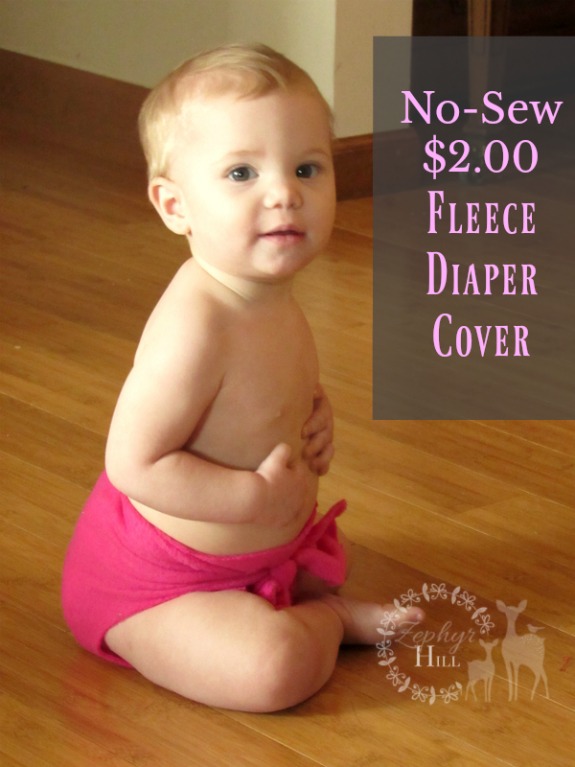
Here is the finished cover. Obviously, it’s not perfect, since I just eyeballed it and started cutting around the shark diaper. But it fit Mary Kate just fine. My next cover will be better because I’m going to use this one to make a brown paper pattern.

The kind of fleece that you use matters, so cutting up an old fleece blanket or re-purposing a pair of fleece pajama pants might not be your best bet. You can buy a yard of polar fleece at Walmart or on Ebay for anywhere from $3.00 to $5.00. From each yard, you can make 2-3 covers, depending on your baby’s age, so the price for each cover averages about $2.00. If you do want to try this with old or thin fleece, I strongly suggest doubling up your covers (i.e. cut out two and use them one on top of another).

For my testing, I used a prefold diaper, folded in thirds. After wrapping the diaper and cover around Mary Kate, I tied up the wings in the middle.

If the rise is too high, you can just fold it down a little at the front, but mine was just right. I think the front ties make this a pretty cute little cover.

Here are the finished dimensions, which should fit an older baby or a small toddler. If you’re unsure about sizing for a smaller or larger child, just trace over a cover that currently fits him, like I did.

I let Mary Kate crawl around and play for more than an hour in her prefold and fleece wrap. Surprisingly, there wasn’t much shifting and everything pretty much stayed in place. Fleece has a natural stretch and give.

After two hours I changed her. The prefold was almost completely wet, and there was a little bit of #2, but everything was contained. The fleece was still dry.

I wouldn’t recommend going past the two-hour mark with this fleece cover because fleece is prone to compression leaks. Also, there isn’t any elastic in the legs for extra protection against blowouts. This cover is super cheap, comfortable, and has a stay-dry quality, but it’s definitely not in the same league as a waterproof PUL or wool cover.

Fleece is also known for holding onto odors if you don’t have a good wash routine. HINT: You can boost the water-resistant quality of fleece by using fabric softener.

Final thoughts: It feels good to actually make a diaper cover for your child! And this one was cheap and dead-easy. I feel like this bare bones diapering method could work for a family that’s literally pinching pennies. If they couldn’t afford prefolds, they could double up on flour sack towels or use old t-shirts. Night time would be tricky if you had a heavy wetter. Perhaps you could use two of these fleece covers together for extra protection?

A cheap fleece cover like this is also a good emergency diaper option, or a way to get started with cloth diapers without having to spend money on a set of PUL or wool diaper covers.

Filed Under: Cloth Diaper Reviews, Cloth Diapers Tagged With: cheap cloth diapers, cloth diaper sewing, DIY diaper cover, fleece diaper cover, no sew fleece cover

Little Bear Bums Fleece Cover Review

July 15, 2015 by Anne Marie 2 Comments

bearbums1

Ever tried a fleece diaper cover? The ones you find at Little Bear Bums are a little bit different. You can choose from two different kinds of covers – microfleece (which start at $10) and Windpro (which start at $16). They are sized for a more custom fit and are available in preemie, newborn, small, medium and large. Besides white, like we reviewed, there is also a limited selection of colors like chocolate, red, periwinkle and baby blue.

What makes Little Bear Bums different from other fleece covers? First of all, they are made with 2 layers of microfleece, instead of the typical 1 layer of polar fleece. This gives you good wetness protection but with a slightly more trim fit. Microfleece is a bit finer and softer, plus easier to rinse out and clean than thick polar fleece.

As a bonus, Little Bear Bums covers close with snaps and wrap around your baby; this is SO much more practical to me than the typical “fleece soaker” style that you have to pull up and down like underwear.

Because this is a sized cover, there is only 1 row of snaps, and those are for fastening the waste. There are crossover snaps for very skinny babies.

bearbums3

The Little Bear Bums cover has enough “give” to that you can use it over many types of diapers, including fitteds and flats and prefolds. Fully opened, the size medium stretches to about 16 inches long, which is perfect for medium to large trifolded diapers and padfolded flats. I’ve used also used the cover with bamboo pocket diaper inserts.

The elastics at the back and around the legs are so soft and gentle, one of my favorite things about these covers.

bearbums4

I think this soft little diaper cover looks so sweet and cozy on Ingrid. As you might already know, fleece performs similarly to wool in some ways, but it’s extremely easy to care for. Launder along with your other cloth diapers, and to improve the water-repelling ability, throw in the dryer with a dryer sheet every once in a while.

bearbums5

Here’s a picture of the Little Bear Bums microfleece diaper cover in the newborn size, which I used when my babies first arrived:

IMG_1961

You might be curious about fleece as a diaper cover material. As with anything, there are pros and cons. It’s soft, fairly breathable and water repellent. However, it is not water resistant like PUL. Fleece does not feel wet and cold like a PUL cover does when the diaper inside is saturated. For chunky legs and sensitive skin, fleece is very gentle. Fleece is a great alternative if you have a baby who is allergic or hyper-sensitive to natural wool or PUL. It also dries super fast.

With a fleece cover you’ll need to be careful about compression leaks; that’s when the wet diaper underneath begins to wick moisture onto the fleece. What happens when moisture hits the fleece? It goes right through! That’s what fleece is designed to do. So make sure you have a very absorbent diaper under your fleece cover. Also, it may not be the best choice if you have a tummy sleeper that puts a lot of pressure on the front of the diaper while sleeping. Another thing to be mindful of: fleece is synthetic and may start to hold onto odors over time. A good stripping can help with that, as can a “splash” of bleach in the hot wash cycle every couple of months.

You can read more about the advantages and disadvantages of fleece diaper covers in this post.

Shop for Little Bear Bums fleece diaper covers at the Hyena Cart shop, and follow on Facebook for news and stocking updates.

I don’t want to wrap this up without mentioning another product I love at Little Bear Bums – her washable mama cloth! I have tried many MANY different brands and styles of pads over the years, and these are hands-down some of my favorites. They are even nighttime and postpartum worthy. They may not be flashy, but they work. Little Bear Bums pads feature a synthetic core and a stay-dry microfleece top with channels sewn in to help lock away moisture. The backing is waterproof PUL in a variety of colors. There are two snaps on the wings to help you get the best fit.

Granted, cotton would be my top pick for the fabric, but experience has taught me it does not whisk away liquid quickly enough. My first few cycle days are heavy and fast; this is honestly one of the few pads that has fully protected me from overflow and leaks. This is the only brand of pad I’ve come back for a second and third time to buy. Did I mention they are easy to clean and rarely, if ever, stain?

Interested in adding some of these reusable (and money-saving) pads to your routine? Send Little Bear Bums a message on Facebook. Price varies according to size, but they are super reasonable. My nighttime/postpartum pads were only $8.00 each! Most of the bigger pads on the market are at least ten apiece.

bearbums2

What do you think about fleece diaper covers? If you have any questions or comments, please use the reply form below!

annesignature

Filed Under: Cloth Diaper Reviews Tagged With: fleece diaper cover, Little Bear Bums diapers, newborn diaper cover, newborn diapers

How Do Fleece Diaper Covers Perform?

August 8, 2013 by Anne Marie 23 Comments

If you’ve seen fleece diaper covers in stores or shops and wondered how well they perform compared to the more popular PUL covers, read on! Fleece is a synthetic poly fabric that works by drawing moisture away from the skin (or from the diaper underneath it), through its fibers to the outer surface. It’s often marketed as an easy-care alternative to wool.

I used fleece wraps on Samuel when he was little because they fit great over his chunky tummy and legs. And when Erik was born last December, one of my favorite newborn covers was the Little Bear Bums microfleece. It was so cozy! I have it stashed away in case we have another….

ADVANTAGES

If you’ve never tried fleece before, here are some of the benefits:

  • Fleece is easy to clean and dries fast; you can wash it with your regular laundry (if you like) and use dryer sheets occasionally to boost its repelling properties.
  • Fleece is cheap; handmade covers start at just $5 and go up from there.
  • Fleece is soft and gentle; not once did it ever leave marks on Sam’s fat little legs like PUL covers sometimes do.
  • Fleece has some of the benefits of wool (soft, breathable and water repellent) but without the higher price tag.
  • Fleece pants can do double duty as a diaper cover and an article of clothing.
  • Fleece covers can be re-used before washing if not soiled or stinky.
  • Fleece has a stay-dry quality which is nice for the parts that might touch your baby (waistband, gussets).
  • Fleece can be a skin-friendly option if your baby is sensitive to PUL or allergic to wool.
While shopping for fleece covers, I learned that it’s important to go for high quality fabrics if you want nap or night-worthy protection. Windpro/Malden Mills is the best. Although bulkier than regular fleece, the price is not that much more, and a cover made out of this will be better at holding wetness at bay.
All fleece is not the same; the thin microfleece layer that lines a pocket diaper is NOT suitable material for a fleece soaker or cover.
We diapered Samuel (now 3) as a baby in the bulletproof Wallypop “Fleecy Wraps.”


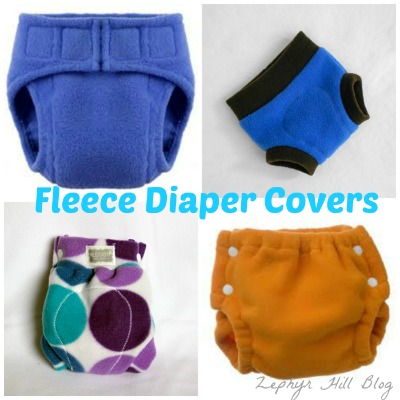
Fleece covers come in three basic styles: soakers, wraps and pants (either shorties or longies). Staccinator and Happy Heinys both make a popular snapping cover, and the pull-on soakers can easily be found by searching on Etsy or Hyena Cart. This style is also extremely easy to sew on your own from free patterns.

Update 2019: I made my own fleece cover pattern! Check out my No-Sew $2 Fleece Diaper Cover Tutorial.

DISADVANTAGES

As with every fabric, there are some drawbacks. Here’s what I learned while using fleece covers:

  • Fleece (as mentioned before) is water-repellent, but it is not waterproof like a PUL diaper cover. More frequent changes will be needed.
  • Fleece can result in compression leaks when the diaper underneath is soaked. The more thick and absorbent your diaper is, the better a fleece cover will work. The trade-off is that your baby is going to have a bulkier bottom.
  • Fleece is synthetic so over time it might become stinky from trapped odors and detergent buildup, unlike wool. Use a good, strong detergent for thorough cleaning, and consider a good stripping if you suspect there’s buildup or detergent residue.
  • Fleece is not as stretchy as wool, so you have to get the sizing right to make sure it’s going to fit over your prefolds and bulkier fitteds.
  • Fleece is not typically available in the “one size” option, so you have to buy over and over again as your baby grows.

You might be wondering Can I use fleece covers overnight? The answer is yes. Many mothers do this, but remember it’s mainly the diaper underneath and not the thick fleece cover that you are relying on. You have less wiggle room with a fleece cover vs. a wool or PUL cover. It also pays to make sure there’s extra padding up front if you have a tummy sleeper, because this is where you might experience compression leaks through the fleece.

Overall, I had a good experience with our fleece diaper covers, as long as I didn’t go too long between changes. However, I still prefer PUL and wool covers for more insurance against leaks over long periods of time, a trimmer fit and the fact that they will fit a wider range of sizes.

Have you ever tried fleece covers before?


Filed Under: Cloth Diapers Tagged With: do fleece covers leak, do fleece covers wick, fleece diaper cover, fleece soaker

SOCIAL MEDIA

Newly Published

  • The Coop Upgrade Nobody Talks About Until It’s Too Late
  • Ignore the Radio Ads About Life Insurance, But Please Read This Post
  • Do Catholic Parents Have to Choose a Saint Name for Their Baby?
  • The BEST and Most Comprehensive Baby Name Books for Parents
  • Educational Games to Enjoy With Your Children

Popular Posts

  • Stashify Bamboo Flat Diapers Review and Giveaway
  • Link City: a Cooperative Family Game
  • Super Undies Nighttime Trainers Pants Review & Giveaway
  • 5 Ways to Give Your New Pet a Healthy Start
  • 5 Things That Make Teaching SO Much Easier for Me!

Copyright © 2026 · Zephyr Hill Blog · Design by Albemarle PR

Copyright © 2026 · Albemarle PR - Hannah Template on Genesis Framework · WordPress · Log in