Zephyr Hill

A Family Blog

Header Menu

  • Home
  • Contact Me
  • Terms / Privacy
  • Homeschooling
  • Faith and Family
  • Book Reviews
  • Cloth Diapers
  • Pets

Measuring too Small? The Ultrasound Answer

August 10, 2012 by Anne Marie 2 Comments

There was some concern about my due date because I measured small at my last appointment. By my cycles (which are extremely regular), I was 18 weeks along, but my uterus measured 14 weeks. I was a little bit worried that something might be wrong with the baby’s growth, or that my due date was going to get pushed up another month.

I do tend to measure small with pregnancy, but never as much as 4 weeks. So an ultrasound was ordered and we got the results yesterday.

I really am 18 weeks along! Whew!

My only explanation is that I must carry very low and that affects how I measure from the outside. After all, this is my 7th baby. Everything is getting lower these days!

Here’s a picture from the ultrasound. We are keeping the gender a surprise.

Filed Under: Faith and Family

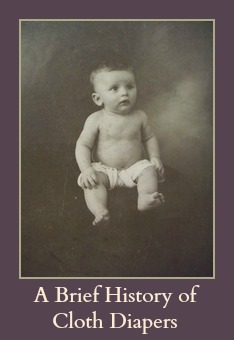
A Brief History of Cloth Diapers

August 9, 2012 by Anne Marie 44 Comments

diaperhistory3

Wrapping a disposable diaper around a baby and tossing it in the trash when full is a far cry from the way our great-grandmothers diapered their children. And even though I do a lot of cloth diapering, I know that even that experience is very different from a mother of two centuries ago in America.

Because I love history (my major in college) it seemed like a fun idea to take a trip down memory lane and peek in on the ladies of yesteryear as they cared for their babies’ most basic needs.

The First Settlers

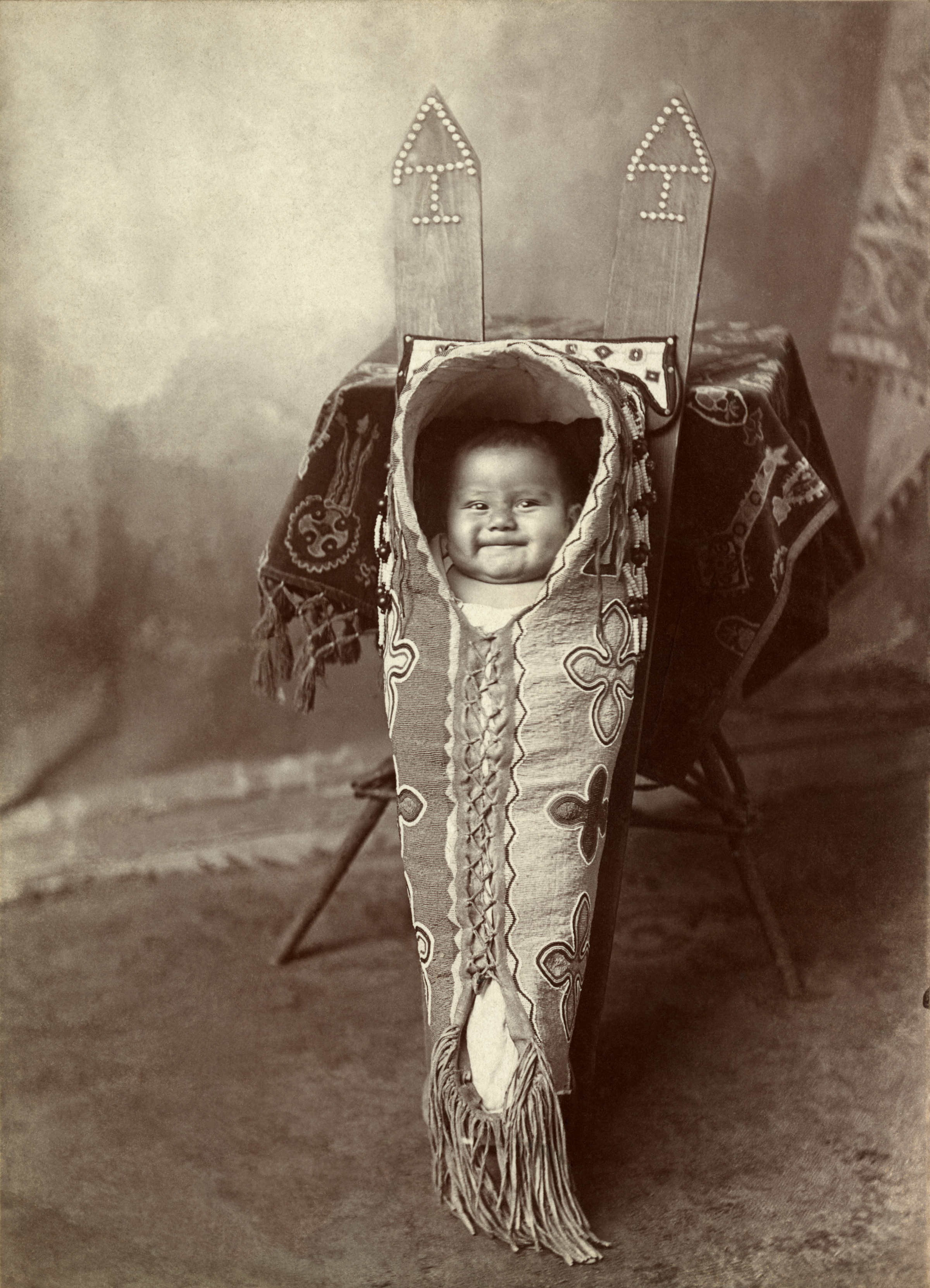
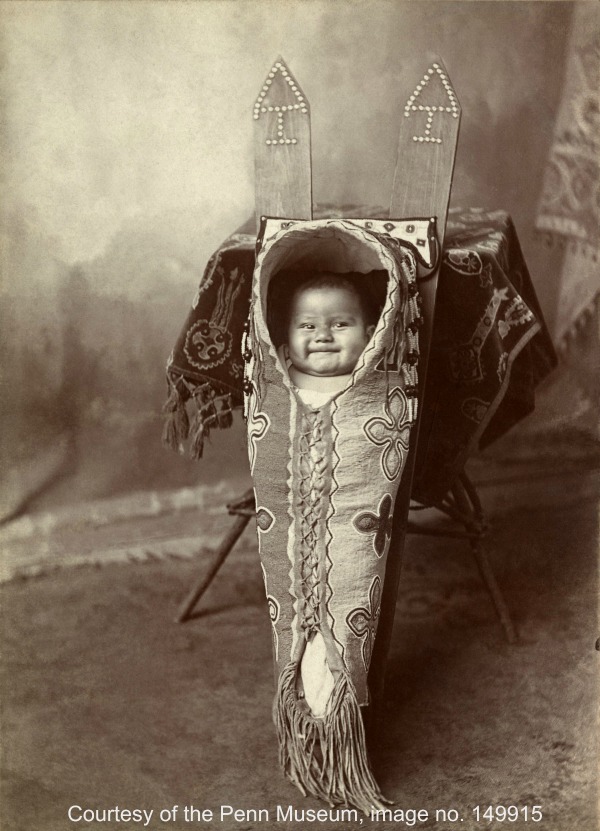
Let’s start first with the earliest settlers in America – the Indians. Practices varied from tribe to tribe; if the weather permitted, babies might go without pants (and would potty train early). Absorbent materials like moss, grass or weeds might be stuffed around a baby’s bottom before he was wrapped up tightly in a cradleboard. When soiled, the materials would be discarded and decompose naturally. Herbs and plants that were beneficial to the skin included sphagnum moss, juniper bark and clifforse.

In colder climates, natives might use covers made of animal skin. Take a look at these sealskin Eskimo baby pants, complete with ties! 

Baby Care in Early America

From the Colonial times until the late 1800’s, the task of diapering a baby remained virtually unchanged for American mothers. Diapers were made from cotton, muslin, flannel and linen. This was a good project to work on during those nine long months of pregnancy, and a useful way to re-purpose worn-out clothes and linens.

Because they were handmade, there was no pre-determined shape; they might be squares, rectangles or triangles and would be fastened on with buttons, sewn-on ties or straight pins (you can actually still buy “tie on” cloth diapers today). Wool covers were sometimes used, but generally babies wore only the diaper and were changed frequently.

Diaper rash would be treated with burnt flour or powdered vegetable sulfur.


Trade was brisk in the American colonies, affording women several options. They could purchase yards of special cloth diapering fabric at local shops. It was typically made of imported linen or muslin. Because they were still tied closely to England, Colonial Americans referred to diapers as napkins or clouts. Wool covers were called pilchers. You can see a napkin and pilch on a doll here. 

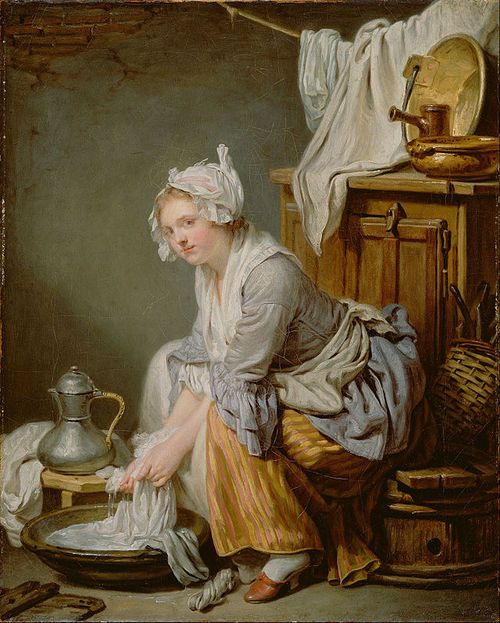
The Laundress by Jean-Baptiste Greuze (1761)

Women who went West as pioneers carried on the same diapering practices, although they wouldn’t have had as many choices, unless they brought a fancy layette with them from back East.

What About Diaper Laundry?

What was done with dirty diapers? It depends on how close to wash day you were! Mothers usually set aside a day or two each week to tend to the family’s laundry, since water was scarce and the work was taxing. So quite often, mother would simply rinse and ring out the wet diapers and hang them to dry; sometimes they were used again.

Although it offends modern sensibilities (and noses), urine was thought to be useful as both a disinfectant and stain remover (thanks to the ammonia). Our ancestors felt no sense of urgency about laundering a wet diaper. The smell of dirty diapers drying by the fireplace wasn’t too pleasant in the winter, but I’m sure the family just accepted it as a necessary reality. And I’m pretty sure it prompted mothers to encourage early potty-training! Young children, no matter their sex, wore gowns that opened at the bottom for frequent, easy changes.

Soiled diapers would be scraped, rinsed and set aside for washing.

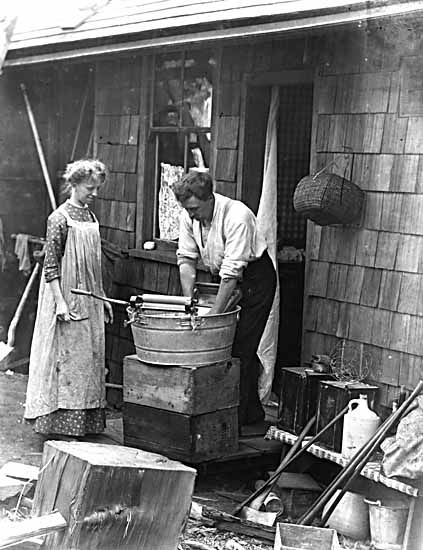
Getting any type of laundry clean in the old days was a chore. After heating large amounts of water (on a stove or open fire) that had to be lugged from a well or spring in big buckets, clothes were sorted into piles. Then the long process of scrubbing and rinsing commenced, and lye soap was not kind to your hands.

Although upper-class women would have had the benefit of housemaids to relieve them of the task of diaper laundry, the process was still virtually the same no matter who was doing it. But it was not uncommon for even a mother of poor or modest means to hire a local girl or woman to help out when a new baby arrived. Famed author Laura Ingalls Wilder did this when Rose was born on the Dakota prairie.

An understanding husband could help with the washing, too, in a pinch!


Ben Leeson and his wife, circa 1901, source unknown

A New Century, and New Innovations

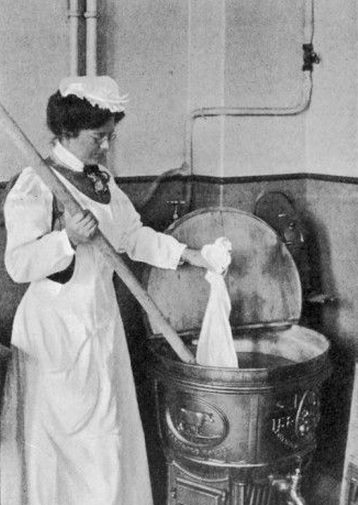
In the late 1880’s, diapering started to change. All-cotton cloth diapers were mass-produced and safety pins appeared on the scene. Mothers were encouraged to sanitize diapers by boiling them before re-using.

boilingDetail of image at allposters, used with permission

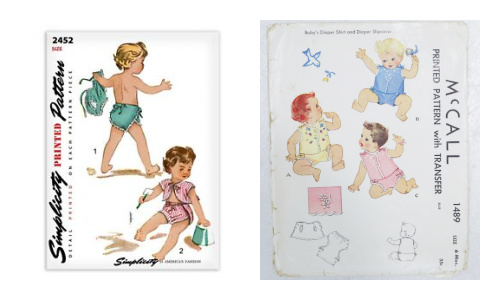
Diapering got another welcome boost in the 1940’s and 50’s when washing machines became more widely available and Curity introduced padded cotton prefolds. With absorbent layers pre-sewn inside, folding was much quicker. But even with modern innovations on the market, a good number of mid-century housewives continued to sew diapers and covers at home.

Disposables and More!

But one thing hadn’t changed. Mothers were still doing a lot of washing because diaper fabrics still weren’t as advanced (and absorbent) as they are now. During and after World War II there was not only a shortage of cotton; changing times resulted in an unfortunate flood of women into the workforce. There was less time for housework, and that meant less time for cloth diapers. American mothers were looking for innovation and convenience. Consequently, it was during and after the war that two big time-savers hit the scene: diaper washing services and disposables!

PauliStróm in Sweden invented the first throwaway, made of paper, in 1942. More innovation quickly followed, with Valerie Gordon’s “Paddi” (1947),  crafted from nylon parachutes, cotton wadding and wool.

One especially prolific inventor, with 20 patents to her credit, was a housewife named Marion Donovan. Her “Boater” (patent filed in 1949, granted in 1950) was a reusable cover using shower curtain material as the waterproof barrier and innovative plastic snaps.

Following that, the Safe-T Di-Dee diaper was invented by Sybil Geeslin in 1950. It was preformed and also utilized snaps. After the patent was sold, this design was marketed as the Keystone Safe-T Di-Dee Diaper.

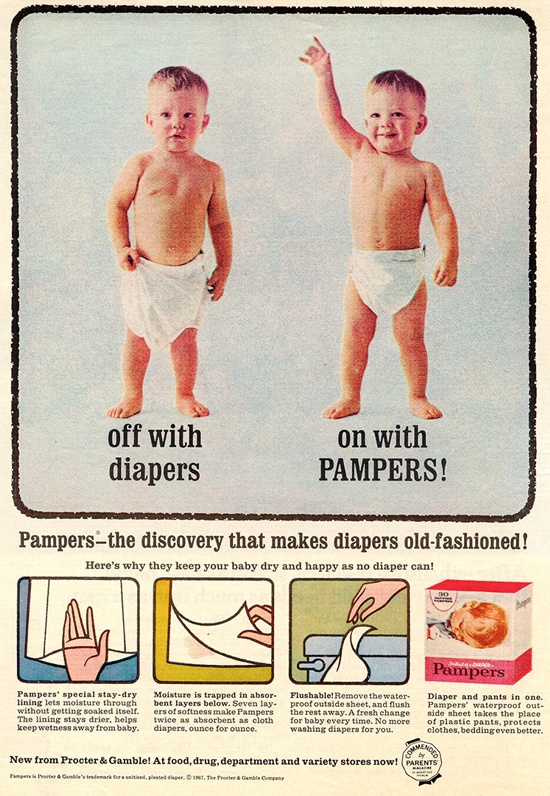
But despite huge progress in the design and performance of washable diapers, disposables had become the wave of the future, boasting four major selling points: (a) convenience, (b) absorbency, (c) trim fit, and (d) a lower incidence of diaper rash. In 1951, Pampers produced its first disposable diaper, complete with a flushable insert. In 1959, velcro appeared on the scene, first used by Riegel.

Pampers Ad, circa 1967, courtesy of FirstVersions.com

As you would expect, cloth diapers fell out of favor, but began to make a slow resurgence from the 1980’s onward, thanks to environmental, health and financial concerns. Some of the early innovators hail from Canada; Kushies designed a cotton form-fitted diaper in 1989, Bummis launched one of the first “modern” waterproof diaper covers in 1987, and Motherease followed with its own fitteds and covers beginning in 1991.

The Modern Cloth Diaper

Brands like Fuzzibunz  (who introduced the modern “pocket” diaper in 1999) helped to make cloth more accessible and less daunting to American families. The revolutionary one-size bumGenius, still a perennial top-seller, made its debut in 2006.

bumgeniusdoll

More styles followed: All-in-One’s and All-in-Two’s, Hybrids, and Hybrid Fitteds. Cloth diapering wasn’t just a movement – it was a trend. And mothers were making it fun (and social) with chat groups, diaper parties, giveaways, and constant clamor for new prints and colors.

Mothers (like me) who cloth diaper today have a much easier time of it. Modern diapers are super absorbent and easy to launder. I don’t deal with issues like boiling and hauling water for wash day (although I do know how to hand wash now, thanks to the encouragement of Kim at Dirty Diaper Laundry). PS: She also has a complete diaper timeline here.

But after doing all this research, I still have a few unanswered questions:

  • Did early American mothers try to make diapers prettier by dying them or using colored ribbons, buttons, etc?
  • How common was diaper rash before disposables were introduced?
  • Where were dirty diapers stored until wash day?

Let me know if YOU know the answers!


Other sources consulted but not cited or linked to:

All photos are either in the public domain or are used with permission.

The Diaper Jungle. The History of Diapers – Disposable and Cloth, http://www.diaperjungle.com/history-of-diapers.html
Archives Center, National Museum of American History. Marion O’Brien Donovan Papers, http://amhistory.si.edu/archives/d8721.htm
The Colonial Williamsburg Official History and Citizenship Site. Fashions of Motherhood, http://www.history.org/history/clothing/women/motherhood.cfm
Wikipedia. Diapers, https://en.wikipedia.org/wiki/Diaper

Filed Under: Cloth Diapers, Faith and Family Tagged With: cloth diaper history, cloth diapering 1800's, cloth diapering on the prairie, cloth diapers in america, cloth diapers in american history, diapering a baby frontier, history of cloth diapers, history of diapers, pioneer cloth diapers, pioneer women cloth diapers

Veggie Tales DVD Review and Giveaway

July 31, 2012 by Anne Marie 25 Comments

Have you heard of Catholic Family Gifts? This is a great online store with a huge selection of quality religious items to celebrate Baptisms, First Communion, Confirmations and other sacraments, as well as bibles, books, videos, crosses and religious jewelry.

The owners of Catholic Family Gifts are the parents of six children and they are proud to nurture the faith of families everywhere through the wonderful products they sell.

There are many wonderful children’s books:

Indoor and outdoor statues and ornaments:

And gifts to celebrate the sacraments:

You can even order custom-imprinted cards to celebrate occasions like baptism:

I was introduced to a wonderful lady named Ruth at Catholic Family Gifts, and when I told her we had lots of young children, she very thoughtfully sent a Josh and the Big Wall DVD for us to review:

The theme of this short 30-minute feature is “Anything is possible with God” and the setting is the momentous battle of Jericho, where the children of God are tested for obedience. Like all Veggie Tales videos, you have the lovable cast of pint-sized talking vegetables, bright and shiny animation and catchy little tunes.

All of our children, from Joseph (age 9) on down to Susanna (age 1) got a big charge out of this little feature. They loved the sneering green peas (with French accents) who sit atop the walls of Jericho and laugh at Israel’s plan to conquer their mighty city. And they rewound the scene over and over again where Jericho pelts the poor children of Israel with ice cold slushies! But the patience of Israel wins out, and their obedience to God’s strange orders to march around the city and blow trumpets lands them the ultimate victory.

Is it better to do things our way, or God’s way? Josh and the Big Wall teaches clearly that His way is best because He loves us and know’s what’s good for us.

Besides the animated featured, there are some cute extras on this DVD – some silly songs, behind-the-scenes clips, Veggie Karaoke, an art gallery and a fun voice-changing game. We love our new Veggie Tales DVD and are so thankful to Catholic Family gifts for adding this to our family collection!

You can find lots of other great Veggie Tales titles just like this one at Catholic Family Gifts. Shipping starts at the very affordable rate of $3.95 and expedited delivery is also available. Be sure to check out the Sale Items at Catholic Family Gifts, with markdowns up to 40%

* GIVEAWAY * CLOSED


Filed Under: Faith and Family, Home and Family Reviews Tagged With: baptism gifts, catholic family bibles, catholic family gifts, catholic family gifts review, confirmation gifts, custom holy cards, discount rosaries, first communion gifts, josh and the big wall dvd, josh and the big wall review, sacramental gifts, veggie tales dvd, veggie tales giveaway, veggie tales review

Birth Center, Hospital or Home Delivery?

July 9, 2012 by Anne Marie 13 Comments

When it comes to labor and delivery, I’ve had a wide range of experiences. Just to illustrate:

#1 (Joseph) was chemically induced at the Army hospital and ended up being delivered via c-section.

#2 (Catherine) was a midwife attended VBAC at the Army hospital, with the usual interventions (IV, epidural).

#3 (Margaret) and #4 (Benjamin) and #5 (Samuel) and #6 (Susanna) were all totally natural VBAC’s and midwife attended at a free-standing birth center.

I’ve never done a home birth before, but have certainly considered it and have many friends who have been very pleased with their experiences. Fortunately, if I ever decide to go this route, we have a wonderful family doctor in the area who will sometimes attend home births, as well as many midwives who offer this service (as well as in-home prenatal care)..

A couple of things that make a home birth attractive to me:

1. I wouldn’t have to go anywhere. I’ve always hated that drive to the birth center when I’m laboring in the cramped back seat of the car and praying we don’t have an accident or collision.

2. I would be in a comfortable, familiar setting.

3. I wouldn’t have to pack any bags.

Where a woman chooses to give birth is a personal decision and (despite what many mothers militantly assert) there is no right or wrong choice.

Basically, we try to pick the setting which offers what we consider to be closest to the “ideal birth.” Our ideal is influenced by past experience, our culture, the media and things like books we read and people we talk to.

For me, the birth center and a midwife-attended delivery have come pretty close to my ideal:

1. I prefer the midwife’s birth philosophy, which is basically that birth is a natural and normal process and that most of the time, everything goes right and needs little help or interference. By contrast, an OB is trained to view birth as a medical procedure and to focus on everything that might go wrong (hence the interventions, monitors, constant examinations, etc.)

2. I prefer the hands-off approach of a midwife during labor. If I don’t need anything, nobody bothers me or comes to examine me constantly.

3. I don’t like the restrictions and red tape that I dealt with in my hospital labors. They would only let me chew on ice chips even though I was weak and ravenously hungry. I was hooked me up to monitors and IV’s “just in case.”

4. I like that my midwife is also a mother and has given birth herself. To me, this makes a difference! When she’s giving me advice or encouraging me, I know that she speaks from personal experience and can sympathize with what I’m going through.

5. I like that when I am giving birth I’m in a place that’s set up just for that. When you enter a hospital, your risk for coming in contact with pathogens or germs is much higher.

6. I like the traditional wisdom that midwives possess to help ease the pain of labor and make delivery easier.

7. I like that the midwife is never in a hurry. She knows that some babies arrive quickly, and others take their time (even a few days!). Busy physicians don’t usually have the luxury of time on their side. Women sometimes get pressured into c-sections if the doctor isn’t satisfied with their “progress.”

8. I like that there is no minimum stay required. Sometimes, my husband and I return home the same day or the next day. We are very eager to return home, introduce the baby to older siblings, and sleep in our own beds.

Now, all of that being said, there are definitely advantages to a hospital birth. It’s still the most popular way to have a baby in America. I have a very dear friend who loves her hospital deliveries, so to present the other side of the coin, here are her reasons for choosing this type of delivery:

1. She loves being able to receive an epidural for complete pain relief as soon as she checks in. Her opinion is that modern medicine has discovered an escape from the pain, so why not take advantage of it? Having zero pain relaxes her and makes labor enjoyable.

2. She likes the constant attention from the nurses, doctors, etc. as it makes her feel they are “on top of things” and looking out for her well-being and that of the baby.

3. She prefers being electronically monitored as it gives her peace of mind about how the labor is progressing.

4. She does not mind any of the restrictions or red tape, as her view is “the doctor knows what he’s doing” and so she chooses to trust his/her judgment.

5. She tends to be an over-anxious person and so being in a hospital makes her feel 100% secure should anything go wrong.

(Note: midwives are trained to provide basic emergency care to mother and baby and are also trained to know when a labor requires immediate transfer to a hospital. Infant mortality statistics are roughly the same for hospitals as they are for midwives – 1.7 per 1000 births)

6. She likes being able to stay on a few days after birth and get some rest without having to worry about her other children, laundry, etc.

So there you have two different perspectives!

What is your preference?


Filed Under: Faith and Family Tagged With: doctor vs. midwife, home birth, hospital birth vs. home birth, hospital birth vs. midwife, infant mortality statistics, midwife statistics, natural childbirth

A Common-Sense Approach to Tantrums

June 18, 2012 by Anne Marie 28 Comments

tantrums1

Tantrums usually peak in the toddler years, and by that I don’t mean “the terrible two’s.” Defiance can rear it’s head even before a child reaches the age of one, and why should that surprise us, human nature being what it is?

Modern magazines and parenting books usually offer the same type of advice. Either ignore the tantrum  or get down on the child’s level and attempt to reason. Don’t do either of these things. Hahaha!

  • Ignoring (or distracting) a child who’s having a tantrum is evasive and weak. You’re missing out on a teachable moment, the chance to show him that tantrums will not be tolerated and that emotions can be controlled. Yes, I know, they are young, but baby steps, right? Ignoring is also ineffective because many parents don’t realize that children don’t just throw tantrums for attention. More on this below!
  • Trying to reason with a young child has its limits. We’re mostly dealing with 1 and 2 year olds at this point, and children are not communicating well at that point. Besides, am I the only one who finds it extremely difficult to have a calm and rational “discussion” with a child who’s screaming and flailing on the floor? 😉

Why do tantrums happen?

Most children don’t throw tantrums just for attention. They throw fits because they are angry or frustrated. Something didn’t go their way. Someone didn’t give them what they wanted.  A toy didn’t work the way it should. Whatever the reason, they “lose it” and collapse under weight of uncontrolled emotions. It’s rage, hurt feelings or defiance, or sometimes a lovely mix of all these. And this very small and immature person is begging for a firm and loving response from the parent.

You can, and should, teach your toddler that a tantrum is not an acceptable way to deal with anger. This is true for all of us, right? Ever seen an adult throw a tantrum? It happens, and it ain’t pretty. Society will thank you for instilling these lessons early on. And contrary to modern pop psych, it’s not kind or loving to allow children to have tantrums and become victims of their own emotions. They need and want loving discipline.

The traditional and time-tested approach to tantrums is a common sense one.

  • Tantrums are not acceptable.
  • We begin early to teach our children how to deal appropriately with harmful emotions.

Can you give an example of how to deal with a tantrum?

Yes, but first think about how you react to other behaviors in your home that are not acceptable. You stop it in its tracks. Teach and discipline the child in an age-appropriate way. And hold the line. Let your no mean no.

Scenario One: Being Told No

Let’s suppose my toddler wants some juice. I say to him “Ok, just a minute.” He falls on the floor and begins to whine and cry because he has to wait. I very swiftly pick him up and make him stand. “No!” I tell him very firmly. He starts to whine and cry again, but before he can fall on the floor, I grab him so he can’t. “No falling out!” I say, looking him in the eye to show I mean business. I repeat this until he’s quiet and standing and willing to listen. Then I say “Can you wait just a minute for your juice?” If he pouts or doesn’t answer, I’ll coach him. “Say, yes, Mama.” After he says it nicely, I will tell him “That’s good. Next time, I want you to be a sweet boy like that. Ok?” This whole process might take a while and that’s ok. Learning is a process, and the younger you are the longer it takes.

While addressing the child, do not get down on the floor or on your knees in what I call the “submissive pose.” Yes, it’s fine to lean down and address a very small child, but it’s most effective if you tell him to look UP at YOU. You are older and bigger and you should use these assets in your favor. If necessary, physically model or reinforce the behavior you are expecting (be quiet, be still, stand up, etc).

Scenario Two: Anger Outbursts

Another scenario. My toddler is playing with his toy. His baby sister comes up and takes it. He screams bloody murder and a tug-of-war ensues. Both are now screaming in anger. I tell him “No screaming!” and if he doesn’t stop, I come over and give him “the look” while again telling him to stop screaming. If he doesn’t obey, he’s disciplined. If he’s quiet, I will then begin to mediate. “Let go of the toy.” Now I will teach him to say “please” or something else nice to the baby, and see if she will hand it over. If not, I will ask her myself (this often works because it’s Mama). She gladly gives it to me with a smile. I hand it to my son and teach him to say “thank you!” to his sister. I will then remind him “Next time be a sweet boy to your brothers and sisters. They love you!”

tantrums2

Scenario Three: Defiance

My toddler has a dirty diaper and is playing in the living. I come up and say, “uh oh, let’s put down the toys; it’s time for a change!”  My son starts to whine as I put him on the changing table; he obviously does not want this. As I begin the change, he wiggles and protests. At this critical juncture, it can be ok to dangle a toy or something for distraction, as you tell the child to be still and he complies. But more defiance warrants discipline. Why would you let a blatant challenge go unanswered? This undermines parental authority and will end up burning you in thousands of ways over the coming days…and years. Like I said before, baby steps.

Whatever you do, don’t forget consistency! Sticking to your guns is as important as dealing with the tantrum itself. That means repeating these scenarios 100 times if necessary. Don’t give up. Don’t give in. Some young children, depending on temperament, take a long time to learn any given lesson. And the moment you throw your hands up, then they know you aren’t as committed as you should be.

Swift action, physical discipline and instruction DO work. They are time-tested methods, and thousands (if not millions) of years old. One day, your child will stop giving into fits of anger. One day he’ll ask you for help with a toy instead of throwing it across the room – or at another child! One day you will hear him ask “Could I have my car back?” instead of yelling and shoving his brother to the ground. One day you will tell him “No, we can’t buy that today,” at the store and he’ll ask “Maybe for my birthday?” instead of crying and screaming as you put it back on the shelf.

tantrums3

Got questions or comments about tantrums? Please post below!

annesignature


Filed Under: Faith and Family Tagged With: dealing with tantrums, hitting, parenting young children, throwing toys, toddler tantrums

  • « Previous Page
  • 1
  • …
  • 27
  • 28
  • 29
  • 30
  • 31
  • Next Page »

SOCIAL MEDIA

Newly Published

  • The Coop Upgrade Nobody Talks About Until It’s Too Late
  • Ignore the Radio Ads About Life Insurance, But Please Read This Post
  • Do Catholic Parents Have to Choose a Saint Name for Their Baby?
  • The BEST and Most Comprehensive Baby Name Books for Parents
  • Educational Games to Enjoy With Your Children

Popular Posts

  • My Home Birth Story: Full of Surprises
  • Organics by Ti Bamboo Flats Review & Giveaway
  • Home Schooling with Limited Space
  • 5 Ways to Handle Food Throwing and Messy Eating
  • Outside-the-Box, Delightful Gift Ideas for 2022

Copyright © 2026 · Zephyr Hill Blog · Design by Albemarle PR

Copyright © 2026 · Albemarle PR - Hannah Template on Genesis Framework · WordPress · Log in